Ancient Forces
This week: the fight for Soho, and the drawbacks of local democracy. Also: some things that aren’t older than sharks; and a shadow map of the world.

The Soho Society dates from 1972, when it was founded to defend the heart of London’s West End from the sinister forces then threatening its character. The greatest threats to Soho at the time involved a wave of new offices, which is the sort of thing that seems pretty much inevitable in the city-central business districts of advanced service economies; and the growth of the sex trade, which doesn’t.
Within a few months, Westminster City Council had given the charity a statutory role, entitling it to consultation “on all planning, licensing, traffic and environmental matters” between Oxford Street and Piccadilly Circus. The Society extended the Soho Conservation Area; it created the Soho Housing Association. “Without the Soho Society,” its website claims, “it would all have been bulldozed in 1974.” Why, it doesn’t explain. But there were enough modernist schemes to demolish bits of London doing the rounds in the early 1970s that we shall be generous.
Today, the charity still claims to listen to and represent “all the people that have Soho in their lives... Residents, workers and visitors”. Some, though, are more equal than others, and in recent years the society has acquired a reputation for ignoring those who work or socialise in Soho in favour of the much smaller group who actually live there. It may not speak for all of them, either. In May, the Guardian reported that its membership was believed to include roughly 10% of the area’s population which, if accurate, would mean it represents fewer than 300 people – a fraction of the number that some of the area’s larger nightlife venues can hold on a busy night. The membership is thought to skew older, too, as such organisations often do.
This, one suspects, explains some of the Soho Society’s odder decisions of late. It opposed the area’s short-lived night time pedestrianisation, introduced in 2020-1 to help hospitality businesses survive a period in which indoor socialising was impossible. Last May it voted at its AGM to challenge all applications for bars and restaurants in the area, including any review of existing licences. It voted to object on principle to any venue wishing to open beyond “core hours”, which end at 10.30pm midweek and midnight even at weekends, too. None of this makes sense if the society’s purpose is to protect the existing character of Soho (it’s a significant nightlife district), or to represent workers or visitors (who like it that way). If its primary purpose is to represent the interests of residents, though, then that’s a different matter.
Westminster council, too, is incentivised to prioritise the needs of the residents on the electoral register over anyone who has a different relationship to the space it occupies. That goes some way to explain not just the end of Soho’s pavement cafe culture, but the council’s long standing opposition to pedestrianising Oxford Street under both Labour and – more frequently – Tory administrations. It explains, too, last week’s imbroglio over “vertical drinking”, which forced the council to panic-publish a “myth-busting” Q&A about its suggestion that it preferred table service to people standing around outside pubs. (Entirely genuine sample Q: “Aren’t you being the fun police?”).
In some ways the furore this has triggered is terribly unfair. Yes, many residents of Soho are rich property owners who want the convenience of central London without any of the downsides, and quite frankly f*ck those guys. Others, though, are social housing tenants for whom the alternative is not “cash in and move to Orpington” but “put up with the noise or end up who knows where”. And the businesses owners on the other side of this debate are hardly universally sympathetic either: some of them are property barons. If you want to read that side of the argument, this bit from Francisco Garcia in the Fence is pretty good.
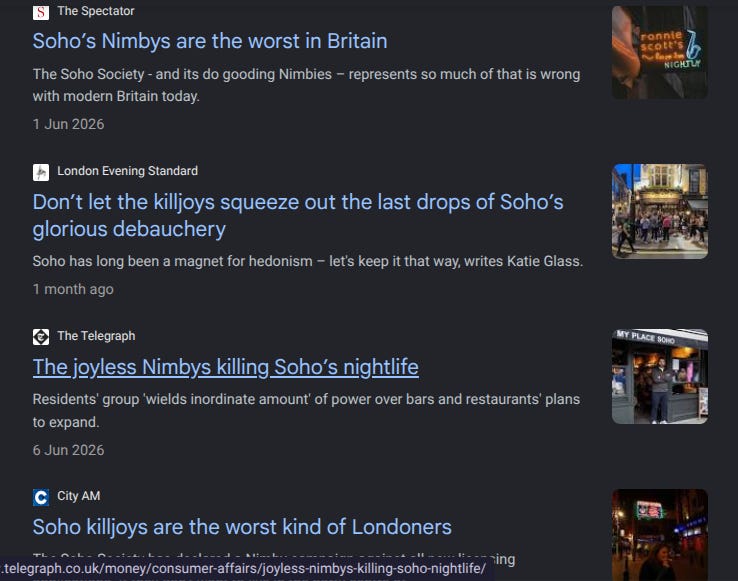
But the attacks on the aforementioned fun police have come from across the political spectrum, nonetheless – the Guardian has accused the society of “destroying Soho’s, reputation”, Unherd has argued that “Curtain-twitchers have killed Soho”. It’s not hard to see why. Soho is not just any other pleasant urban village, but an area of importance to the entirety of London. Almost everyone who lives in, works in or even visits the city will have made use of it at some point: but the nature of local democracy means that only the tiny number who actually live there get to influence its future.
Other models are, of course, available. A couple of miles east of Soho, another slightly archaic body has disproportionate power over a different square mile of the capital. The City of London Corporation governs the original Roman City in the manner of a local council. Yet it represents not just the small number of residents, but the businesses based there, too. I’m picking my words carefully here, because I don’t think the City of London is a model either possible or advisable to copy – Google “city’s cash” and see how fast your eyebrows raise – and granting businesses voting rights, as the Corporation does, gives one the political equivalent of the ick. But it is a reminder that local democracy doesn’t have to mean handing residents a veto over areas of city-wide or national importance. You can structure things other ways.
After all, when the Soho Society claims to represent “all the people that have Soho in their lives”, that could include almost anyone. No wonder the mayor has weighed in on the side of the nightlife: some places matter too much to leave their future in the hands of residents alone.
My new book 31 Inventions That Built Our World is out in just two weeks
I’m probably meant to be promoting it, aren’t I? Oh look, here’s one of my favourite pages.
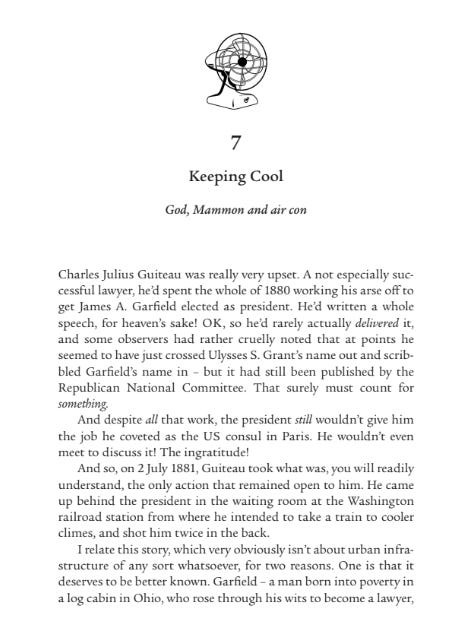
It’s page 72. British/Irish/Aussie/Kiwi readers can pre-order from the retailer of their choice here; American and Canadian ones will have to wait til October, translations to follow.
Also, come hear me talk about it.
And now, back to the show.
Some things that aren’t older than sharks
It will probably not surprise you that the exact age of any individual shark can be quite difficult to determine: you can hardly ask for their birth certificates. With those species that have hard tissues, you can count the growth bands on their fin spines (if they have them) or vertebrae (if they don’t). With those who lack such tissues, you can instead do something whizzy involving carbon dating and a protein in the eye. All of these techniques, however, will require a measure of cooperation that a shark may not be minded to provide, and some of them will result in a dead shark.
What we do know is that some sharks are very very old indeed. Greenland sharks – one of those soft bodied species I mentioned – grow extremely slowly, less than 1cm a year, but one five-metre female is believed to have been between 272 and 512 years old. Even at the lower bound of that estimate, that’d make the species the longest lived vertebrate on Earth.
This seems oddly appropriate – because sharks have been around an extremely long time. The first sharks evolved as long as 450 million years ago, a mere 89 million years after the Cambrian Explosion which marks the emergence of complex life into the fossil record. Here are some things that have happened to the universe since:
Trees. If you had to guess which were more fundamental to life on Earth, the big woody green things sticking out of the ground, or the bitey grey ones that live in the sea, you’d just assume it was the former, right? Trees aren’t just life, they’re landscape. But no: life evolved in the water, and plants only made it to land around 470 million years ago (in cosmic terms, very slightly before sharks arrived).
Trees didn’t get going until some time in the Devonian period, at most, 393 million years ago. So: sharks have been around longer than trees.
