Atomic priests and self-replicating cars
Nuclear semiotics, Automania 2000 and a VERY special offer.

Special Summer Offer: 31% off for 31 Inventions
Yesterday, just over 22 months after a flash of inspiration on the third floor of Waterstones Piccadilly, I walked into a basement room in Blackfriars to be greeted by this:
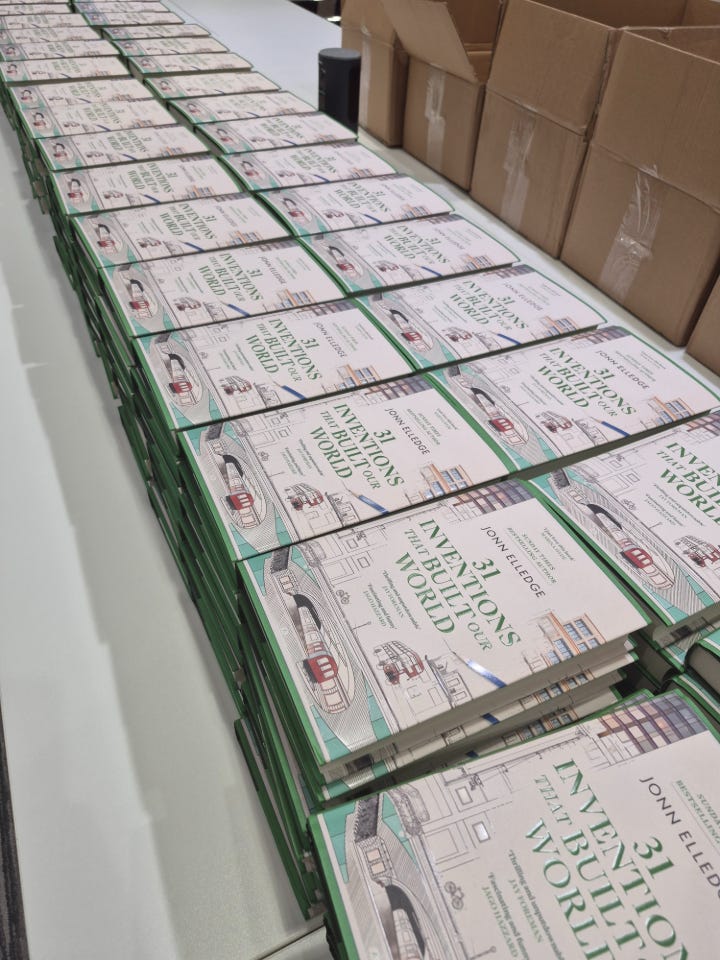
It’s not officially released until 27 August – though history suggests it might start popping up on shelves a little sooner than that – but nonetheless: the book exists. I have a copy right now. You can order yours here.
Since that’s put me in a tremendously good mood, here’s a special offer. To celebrate the imminent arrival of 31 Inventions That Built Our World, my history of all the things that gave us modern urban life, you can have 31% off annual subscriptions to this very newsletter.
Do that, and every week you’ll get to enjoy stuff like the two bits below, both of which span out of my research for the book. Can’t say fairer than that.
Of ray cats, atomic priests and nuclear semiotics
This went to paying subscribers in April.
How could you, as a Roman tavern owner, hope to communicate the availability of delicious and surprisingly affordable wine to the large number of potential punters whose money was as good as anyone’s but who could not, in fact, read? Easy: stick a bush outside your shop. The symbol may have been a reminder of grapevines; then again, it may have represented the ivy associated with the appropriate god, Bacchus. But how it came about didn’t really matter: the point was, people saw a bush, they understood there to be wine. Lovely.
In the same way, it doesn’t matter whether the three golden balls reflected the three bags of gold coins once given by St Nicholas to enable a poor family’s three daughters to marry – an unexpected link between pawnbrokers and Santa Claus, there – or just the heraldry of the Medici family. Everybody knew they meant pawnbroker.
Visual symbols like that, though, are still a form of language, a way of communicating based on consensual understandings about what something means: the red and white stripes of the barber’s pole don’t inherently mean “you can get your hair cut here”, any more than the series of shapes that make up the written word “barber” do: it’s simply that those reading it grew up in a culture in which that’s what it meant.1 So what do you do if, instead of being a trader trying to communicate with illiterate people who share the same cultural assumptions you do, you’re a nuclear scientist trying to communicate with people who may not share those assumptions at all? People who won’t even be born for millennia, whose worldview you can’t even imagine?
In 1981, the US government and engineering giant Bechtel brought together a group of archaeologists, psychologists, climatologists and experts in verbal and non-verbal communication, under the distinctly MCU-esque name of the Human Interference Taskforce. Their mission: to work out how to tell people in the unimaginably distant future that they were at risk of radiation poisoning.
The result was an entirely new field of research, nuclear semiotics, and a whole bunch of proposals which sound less like serious science than something out of a film featuring a shadowy organisation called, well, the Human Interference Taskforce. These ranged from creating a back-up of all human knowledge stored on satellites to protect it from disaster, to founding an “atomic priesthood”, a government-backed religion whose entire raison d’etre was to warn people away from the most dangerous sites. Others suggested using selective breeding to create “ray cats”, which changed colour in the presence of radiation. “Sadly,” Kit Chapman wrote in a great piece for the New Humanist in 2022, “the ability to breed Geiger-counter felines does not exist.”
There are a couple of reasons the taskforce started throwing out ideas that sound like the thing you learn is the supervillain’s evil plan just before the penultimate cliffhanger in a comic book. One is that nuclear waste lasts an extremely long time: the halflife of Plutonium-239 is over 24,000 years, many times longer than the entirety of written human history thus far. Few physical objects last that long; even if they did, no language inscribed on them has come even close.
Another problem is that there is almost nothing you can say about communication that turns out to be universal. Different languages are read in different directions, meaning that a cartoon warning of death in one may look like a miracle cure in another. Symbols are also understood differently in different cultures, and can also change over time: the skull and crossbones can variously mean death, rebirth and pirates, while the three black blades on a yellow background that serves as the universal symbol of radiation is actually recognised by as little as 6% of the world’s population.
Then there’s the fact that something which does seem to be universal among human cultures is an irritating propensity to ignore warnings. Aboriginal Australians’ oral stories about flood risk were ignored by those who came later. And if you’re rolling your eyes about how stupid colonisers can be, it’s worth noting that the people who ignored “Tsunami Stones” built in medieval Japan to warn not to build on this land were also Japanese. You simply can’t assume that people in centuries yet to come will care what you think, whether they’re descended from you or not.
No wonder another of the commission’s proposals involved giving up on communication altogether, and simply covering the danger areas with impenetrable forests of huge concrete thorns. Even then, would you really put it past future archaeologists not to investigate, just as tales of mummy’s curses didn’t stop anyone robbing pharaohs’ graves?
In the end, the US government decided to bury its Waste Isolation Pilot Project (WIPP) in solid rock over 610m down beneath the deserts of New Mexico, then mark it with granite pillars and multiple barriers. Explanations will be left in multiple archives, and warnings written on the wall in seven languages, with space to add more: “This is not a place of honor,” the inscription reads. “What is here was dangerous and repulsive to us... The danger is to the body, and it can kill.” The hope is that, with multiple layers of meaning, the message will get through. Perhaps.
Perhaps, though, this job is impossible. Perhaps there can be no universally understood sign, and what looks to us like a nuclear waste dump will seem, to the people of the future, like Stonehenge: something mysterious and inexplicable but absolutely worthy of attention. Perhaps a similar project in Finland has the right idea: just bury it, and forget – and reflect on the fact that if there are still human beings to find it in 24 millennia from now, then we’re doing pretty well.
Animated anti-car propaganda of the week: Halas & Batchelor strike back
Paying subscribers got this in March.
Science, we are told, has “brought mankind new and undreamt of standards of living”. Something called “elecrtohydromagnetics” has given us “limitless cheap power”, and enabled humanity to “harvest the great hidden wealth of the seas”.
The first sign that this is maybe not the unalloyed boon that the stirring, American voiceover suggests comes when we see the reality of this: a submersible, shaped like an old sweet with a chainsaw on the bottom, cheerfully swallowing every fish it can find.
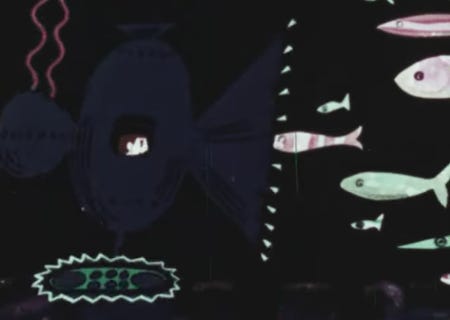
Automania 2000 is a 1963 short from the animation studio Halas & Batchelor, which spent much of the mid 20th century making short information films for the British government. We last met the Hungarian emigree János Halász, and his British wife Joy Batchelor in these parts when I wrote about the seven Charley films (Charley’s Black Magic, Charley in New Town, et al.) commissioned by the Central Office of Information to explain the policies of the post-war Labour government in precisely the way certain of their successors could not be arsed to do. They’re probably best known, though, for their 1954 adaptation of Animal Farm.
The ten minute Automania 2000, however, attained a status their major work did not, when it was nominated for the “best animated short film” Oscar in 1964. This seems particularly impressive because it is a satire of American consumerism, concerned mainly, as the name suggests, with the rise of car culture, produced at what was arguably its height.
The story goes like this. Clever scientists – represented here by a small chap in lab coat and glasses, who hangs out in an observatory which towers over a sea of skyscrapers, and which you can tell is a lab because of all the lights and dials and what look like free floating numbers – have successfully created a “worldwide affluent society”: freedom from want, inexhaustible consumer goods, and the ability to turn fossil fuels into “appetising and nourishing foods”. Lovely.
But “this” – slight dramatic pause – “has created certain problems”. It’s roughly at this point that we zoom down to what can only be described as a literal pile-up.
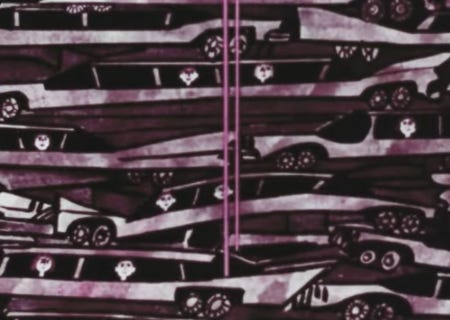
The thing people wanted from their worldwide affluent society, it turned out, was bigger and bigger cars. There was the 40-foot super car; specialist cars for Sundays (with stained glass), dating (a sort of gondola, with flowers) or retired admirals (find out for yourself); even automatic baby carriages, guided by remote control, with a mechanical arm to feed or, more worryingly, change the baby.
Soon enough the cars, and the freeways to contain them, are everywhere. We see them surround and swallow a man and his cow. We see them pile up around global landmarks like Big Ben, Red Square or the US Capitol Building.2 “In the more densely populated areas of our planet,” we are told, “people have been confined to their cars for over five years. The younger children cannot remember the time when it was possible to move around in cars.” On the upside, though, “with universal immobility, war is now unthinkable”.
Luckily scientists have turned their attention to supplying the needs of car dwellers – for food, tobacco, alcohol, medication to deal with the alcohol – communicated via coloured lights and met through goods delivered by helicopter. People seem to be living quite happily – and possibly, in at least one case, in throuples3 – without ever leaving their car.
Alas: those in the lower cars have discovered those in the layers above are better off than them. Everyone wants to be in a higher car, which means that even now the demand is insatiable. So our scientist produces the “ultimate in automation”: a car that can reproduce itself. I won’t spoil the ending but it isn’t particularly happy for the scientist.
You’re only getting the barebones from my summary: as ever with these things, much of the delight comes from the imagery, visual jokes, even the music choices. But what strikes me about this is how modern it feels, predicting the irrational impulse towards bigger and bigger cars which eat up more and more space, over 60 years ago. This film was made at the height of the golden age of the freeway, when cars were seen as a mark of affluence and source of freedom, not congestion; when Robert Moses and his acolytes were still trying to drive interstates through urban areas for the convenience of those driving in from the suburbs – yet it was nominated for an Oscar. The final twist is reminiscent not just of Disney’s Sorcerer’s Apprentice, but Nick Bostrom’s Paperclip Maximiser. It’s a delight. Watch it.
Also – I’m not the only one wondering if Russell T. Davies watched this at some point before writing the 2007 Doctor Who episode Gridlock, right?
Found that interesting? You know what to do.
You can pre-order 31 Inventions That Built Our World – a history of the places where we live featuring sewers, streetcars and skyscrapers – here.
They actually represent blood and bandages, and the fact the line between haircuts and minor surgery was once a lot blurrier than it is today.
It took me a surprisingly long time to confirm it wasn’t St Paul’s – there’s a tiny American flag, which helped – and I had never previously noticed how similar the two are when reduced to a silhouette.
Might also be a small nuclear family. Not clear.