Entitlements, grudges and numbats
This week: a creature that isn’t a wombat, and Oxford’s five hundred year grudge against Henry Symeonis. But first, a rant about education and employers.

The subjects I thought extensively about in my week away included popes and antipopes; the French railway system and the Paris Metro; the contrasting visions of Frenchness presented by Marseille and Lille; and the many glorious qualities of the person I was travelling with. A thing I tried to switch off from entirely was British politics. This was, from some perspectives, a mistake, given what I do for a living, but we are where we are.
More thoughts on at least some of those matters in newsletters to come; you wouldn’t want me to rush my long read on Lille’s innovative use of the first fully automated driverless metro now, would you? So instead here’s some fury inspired by something I read on the Eurostar home, a very good but pretty worrying Guardian feature about youth employment, written by reporter Sammy Gecsoyler and published under the headline, “Young, ambitious and out of work”. With apologies to Paul Clapp, director of the digital marketing agency Priority Pixels, who I’m sure is a very nice chap who doesn’t deserve his comments to be dissected as an example Everything That Is Wrong With Britain Today, that is in fact where I’m going with this, sorry:
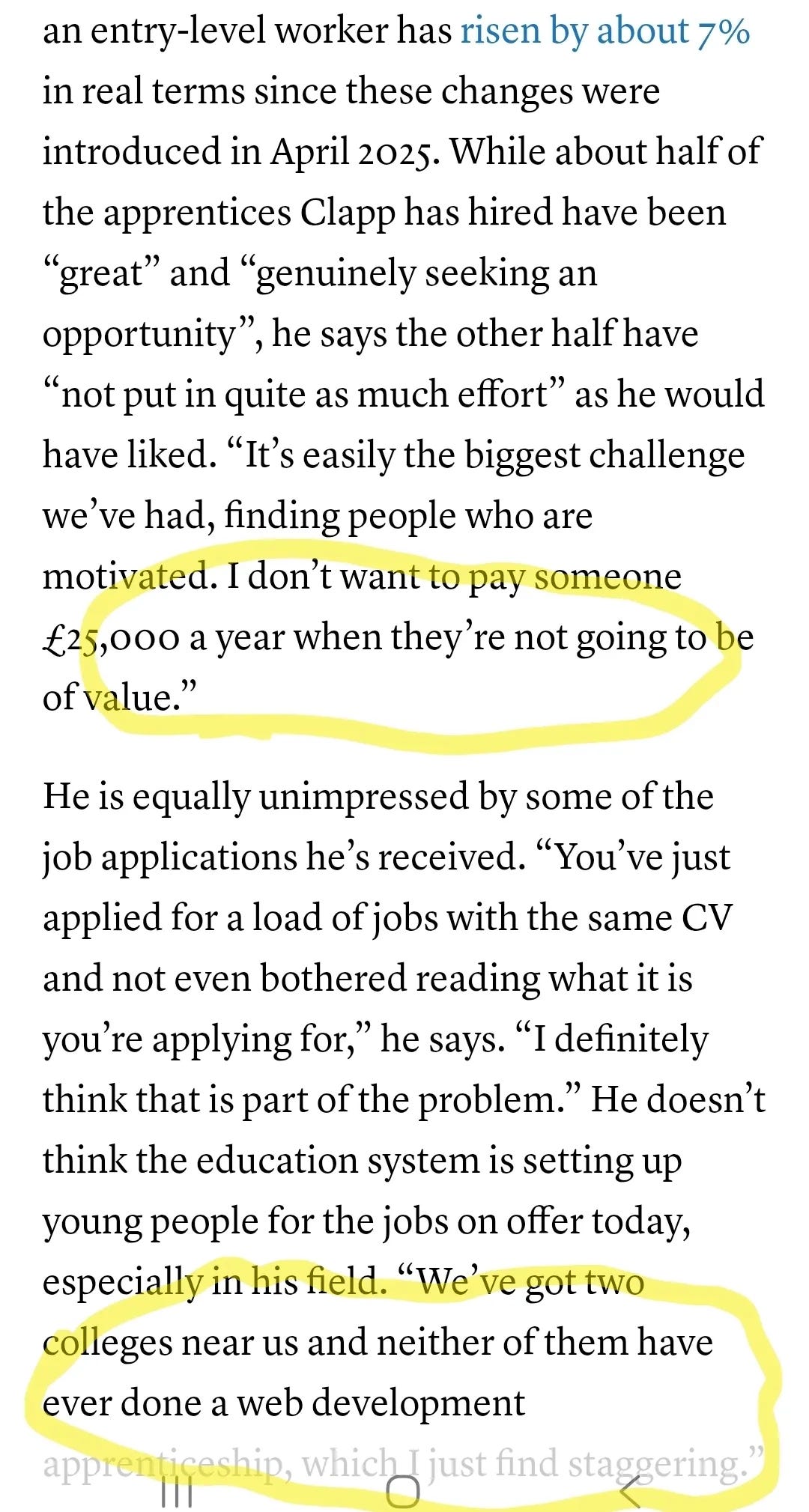
There are a couple of things here that caused the muscles beneath my right eye to start involuntarily twitching, which I’ve helpfully highlighted so I could complain about them on social media. The lesser of them is the implication that young people should be producing thoughtfully personalised applications for starter jobs offering the generous salary of… £25,000 a year.
Given that most of the piece is actually about how job seekers are now sending out literally hundreds of applications to be greeted by stony silence – and given that, for a 40 hour week, £25,000 a year is now less than minimum wage – this seems ever so slightly tin-eared. Obviously using AI to pump out loads of identical applications is bad. But if employers are going to use AI to read applications – or interview applicants, or take their jobs, which is what most of the piece is about – it seems a little unbalanced to tell young people they can’t also use it when applying.
But of course, “tailor your application to the job you’re applying for” is neither new nor controversial advice, and if Clapp has lost track of exactly where the minimum wage stands these days he’s hardly alone, as the frequency of ads for jobs paying less would attest. So let’s move onto the other thing that annoyed me, where I think I’m on firmer ground. Here’s the offending quote again:
He doesn’t think the education system is setting up young people for the jobs on offer today, especially in his field. “We’ve got two colleges near us and neither of them have ever done a web development apprenticeship, which I just find staggering.”
Is it, though? Is it really staggering that publicly funded educational organisations which happen to be based near your company are not providing specialist training in your field, just so that you can employ one or two young people a year? Is it staggering, indeed, that the education system seems under the impression that perhaps professional training is to some degree a matter for employers?
I shouldn’t pick on this guy in particular, I know. Partly that’s because he took the time to talk to a newspaper about youth unemployment, and didn’t necessarily know the context in which his comments would be presented. But mostly it’s because – and this is why I felt this rant worth writing – these are in no way unusual sentiments. Business lobby groups have been complaining that the British education system doesn’t turn out model employees who they can immediately plug into jobs for about as long as I can remember. These comments are so unexceptional, indeed, that we’ve all stopped interrogating them: in 2019, a survey from the CBI found that 44% of employers felt young people leaving education were not ready for work.
But… why should they be? They’ve not been in work. Businesses once understood that training young workers was something they had to undertake themselves. Now, perhaps because first jobbers are more likely to be 22 than 16, they expect the education system to do the entire job for them. Given that it’s often those very same business owners that talk about the need for a competitive tax system, I have some questions about how exactly they’re imagining we’re funding the training they expect someone else to provide.
The reason this annoyed me enough to inspire the sort of screed I normally reserve for whatever stupid thing the government has done this week is because it provides, I think, two different windows into why everything is currently stuffed. One is that it’s a reminder of why AI – or perhaps the misuse of AI – is going to mess everything up. For all the talk of it being a labour saving technology, there’s a very real danger it’ll just increase our output of entirely pointless content. It’s hard to see how the switch to applications both written and judged by AI will improve your chances of getting a job; it’s extremely easy to see how not applying in volumes you can only do using AI might decrease them. It’s bad enough that employers are replacing human workers with AI, of course, but at least you can envision how somebody there might be winning. This just seems to be making everything worse for everyone.
The other thing this story highlights is entitlement. That’s a word we’re most likely to hear in reference to young people who think the world owes them a living. But it’s entitled of employers, too, to assume the education system owes them perfect employees so they no longer need to offer training themselves. As ever, the idea we might owe something to one another – that our responsibilities towards society at large extend beyond paying the minimum legally permissible tax rate – is simply missing from the debate.
A personal note
It’s the third anniversary of the worst day of my life. Don’t worry, I’m not going to write about it again, but it felt wrong not to acknowledge the fact. Here’s the essay I wrote about Agnes this time last year.
One of her favourite bits bits, as a proud Leeds graduate in a world of Oxbridge products, was her attempts to wind people up by pretending to have never even heard of Britain’s oldest university (“Oxford? Is that a bit like Cambridge?”). So, in her honour:
The five hundred year grudge
In 1827 University of Oxford decided to review the written rules and regulations which governed life in the city of dreaming spires.1 By then the university was 731 years old, and some of its statutes had stood unchanged for centuries.
That explained the strange thing those reformers encountered when they came to consider the oath that holders of Bachelor of Arts degrees had to swear to become Master of Arts.
The oddity was not, as one might imagine, simply that you could simply mutter a sort of incantation to magically transform your BA into something that sounds like a postgrad degree2, but was something else entirely. Here’s archivist Alice Millea for the Bodleian Library blog:
As well as being required to swear that they would observe the University’s statutes, privileges, liberties and customs, as you might expect; and not to lecture elsewhere, or resume their bachelor studies after getting their MA, the Bachelors of Arts also had to swear that they would never agree to the reconciliation of Henry Symeonis.
Here’s the full oath, from the Corpus Statutorum (Statute Tit VII section 1):
Magister, tu jurabis quod nunquam consenties in reconciliationem Henrici Simeonis, nec statum Baccalaurei iterum tibi assumes.
Master, you shall swear that you will never consent to the reconciliation of Henry Simeon, nor will you assume again the status of Bachelor.
The shift from “Symeonis” to “Simeonis” isn’t a typo: it’s a mark of the fact this statute had been in place so long it predates standardised spelling.
If you’re feeling shamed by your ignorance of who Henry Symeonis was and what he had done, rest assured that the men running the University of Oxford in 1827 had no more idea than you did. Worse: it soon transpired that no one had known for literally centuries.
