
Patricia Lockwood’s 2021 novel No One Is Talking About This concerns “the portal”: a fully realised alternate dimension, with its own language and stories, villains and celebrities. To most people – most normal people – the portal is neither visible nor, even if encountered, relevant. To those who venture too far inside it, though, the portal can start to seem all consuming: a place of community and opportunity, yes, but also a source of life-ruining obsession.
The portal is not the real world, but the things that happen inside it feel no less real for that. At some point, the protagonist asks her husband to limit her access to this other realm. She ends up showing up to his workplace in the middle of the day, demanding he – and this is where the other shoe should drop – give her her phone back.
No One Is Talking About This is an incredible portrayal of life on social media, given to me by someone who’d grown tired discovering that, while apparently in her presence, I was frequently a dozen posts into an argument she wasn’t even aware was taking place – a behaviour that, at some point, I’d simply stopped registering as in any way weird. For our purposes today, though, the point is that there is a thing there, another realm which is nowhere and everywhere and which isn’t our world but can still somehow have a bafflingly large impact on it. Barbenheimer, “six-seven”,1 Restore’s ability to pile up votes in recent by-elections despite being one angry guy with a Twitter account: all of these have sprung, to a greater or lesser extent, from the portal.
And the mechanism by which much of this happens is what we used to call clickbait. Media commissioning decisions are driven largely by what people are clicking; what people are clicking is driven largely by what people are talking about in some corner of the social internet or another. Whether it’s a TV show or a trend, content will be published because, as it happens, Everyone Was Talking About That.2
But sometimes the thing that sparks all this discourse isn’t geopolitics or an album drop or a casting announcement. Sometimes, the thing the news cycle is responding to is simply the last bit of the news cycle. Someone will say a story is good; others, that it is bad. The two sides will question each other’s motives or credentials, call each other hypocrites, call each other worse. Sometimes this will be done righteously or in good faith; sometimes it will be neither. Others, meanwhile, will conduct meta debates about whether this is really a story at all, whether there might in fact be more important things happening in the world right now – but because they have been asked for 700 words by 4pm they, too, will be contributing to making sure it stays one. Round and round the discourse goes, a perpetual motion machine where every bit of coverage generates the twists and the clicks required to generate the next.
Now imagine that somewhere at the centre of that cycle is not a policy but a person, whose life and career and identity are all being picked apart thread by thread: because of mistakes over which they had some agency, or personal characteristics over which they have none; because of structures and prejudices, which some commentators want to highlight or discuss and others want to abuse or deny; but above all of those because there were clicks to be had, and absolutely nothing to signal that the time had come to stop chasing them.
Even if every individual comment were justifiable, a bar which is never realistically going to be cleared, the combined effect of them is not. Leave aside everything you know about the story – which I’m still not going to name out of some misplaced sense I can merely describe the avalanche, rather than becoming myself another f*cking pebble – and just try to imagine for a moment how all of that would feel. I am extremely glad I don’t know. I pray I never find out.
The title of No One Is Talking About This is something people say on social media when they want people to be talking about this. It refers, too, to the extremely offline twist that takes place at the halfway point of the book, and reframes the protagonist’s entire worldview. But it’s also, to some extent, a wry joke about how a life on social media can reframe your sense of what matters. Issues are elevated in importance by the fact people get positive social reinforcement for talking about them; by the way their friends agree and their enemies argue; but also because, ultimately, they do numbers.
That, I think, is one of the – many – bad things that happened in this mess which, with apologies to baffled overseas readers, I am still not going to name. A story that was real but limited was blown up – because bad people were pushing it; because it generated clicks; just because it was August – until it covered half the British media.
Until, entirely predictably, it became too much for one man to bear.
There’s a form of radicalisation in which it’s not someone’s political or philosophical positions that have shifted, but their sense of how much something matters. A belief that something small and marginal is in fact large and all-consuming can be a sign you’ve got out of step with consensus reality, too. That can happen not just to people. It can happen to institutions. It can happen to entire industries.
The thing is, though, at least when it comes to people, we have built programmes to deal with radicalisation precisely because we understand it can ruin a life.
We used to understand, too, that things that go viral can leave destruction in their wake.
Eight Days / A Week
...til new book is published. 31 Inventions That Built Our World is my history of the places that we live – not the countries, but the settlements and cities and actual stuff around us, all the ways in which we rejigged our environment to make it more amenable to the needs of a bunch of apes with pretentious of grandeur.
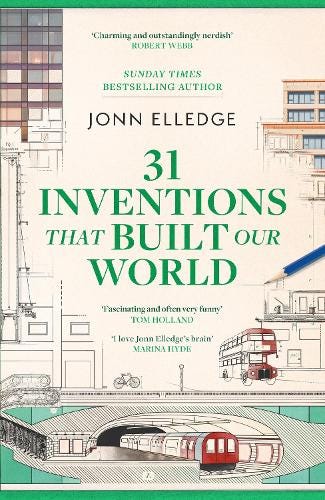
“But Jonn,” I hear literally nobody asking, “what are the 31 inventions covered in your book?” Well I’m very glad you asked. The 31 chapters concern:
Cities themselves;
Walls;
Windows;
Good water in;
Bad water out;
Staying warm;
Keeping cool;
Lighting;
Street grids;
Parks;
Skyscrapers;
Elevators;
Escalators;
Shopping malls;
Horses;
Canals;
Docks;
Buses;
Trams;
Trains;
Tubes;
Bikes;
Cars;
Freeways;
Car parks;
The rules of the road;
Pedestrian crossings;
Signage;
Street numbering;
The Tube map;
Green belts, garden cities and other city limits.
Some of these are obviously more than one invention (or, in some cases, not strictly an invention at all, merely a convenient chapter heading, but, y’know). Oh, and because it has an introduction and conclusion, it also contains 33 lovely drawings, including one of Henry Scampi.
Anyway: it’s out Thursday 27th, you can pre-order from a variety of booksellers here, or come hear me talk about it at any of a surprisingly wide range of places in England, Scotland and Wales.
The first such event will be, unexpectedly, at the Harwell Science Campus on 1 September. Hope to see you there.
Fun with Great Circles
Pick a direction. Start walking. Don’t stop. Eventually, you will end up back at your starting point. Such is the nature of living on a sphere.
You might assume that, spheres being what they are, it doesn’t really matter which direction you pick, and that you will end up back at your starting point after exactly the same distance regardless. As it happens, though, there are two problems with this hypothesis. One of them is that the Earth isn’t actually a sphere at all: it’s an oblate spheroid which basically means that, because of its spin, it bulges slightly in the middle and flattens out a bit at the Poles. The result of that is that the longest walk you could theoretically do before ending up back at your starting point is the 40,075 km (24,901 miles) it would take to go round the entire equator. Do a line of longitude, so that your journey takes you via both poles, and you will only do 40,008 km (a mere 24,860 miles). Any other possible direction will be somewhere between the two.3
The other problem is that, if you keep walking in any direction, you will eventually fall into a body of water, possibly the sea. Rather sooner than that you’ll probably hit a fence or a mountain you can’t climb.
Walking is perhaps not the best way of making these journeys.
Imagine, though, that physical objects are no barrier. Imagine that all that matters is you stay either on water or on land. What’s the longest you could go then?
