How conspiracy theories conquered America
Things have changed a lot since January 6th, 2021.

Last month was a big one for the North American book buying public, as The Experiment published not one, but two of my books in updated Region 1 editions. Elledge’s Non-Trivial Trivia is essentially the same book as The Compendium of (Not Quite) Everything, with a few phrases americanised and a couple of bonus entries – but rather a lot has happened in the world of conspiracy theories since 2021, meaning that Conspiracy required a more substantial update.
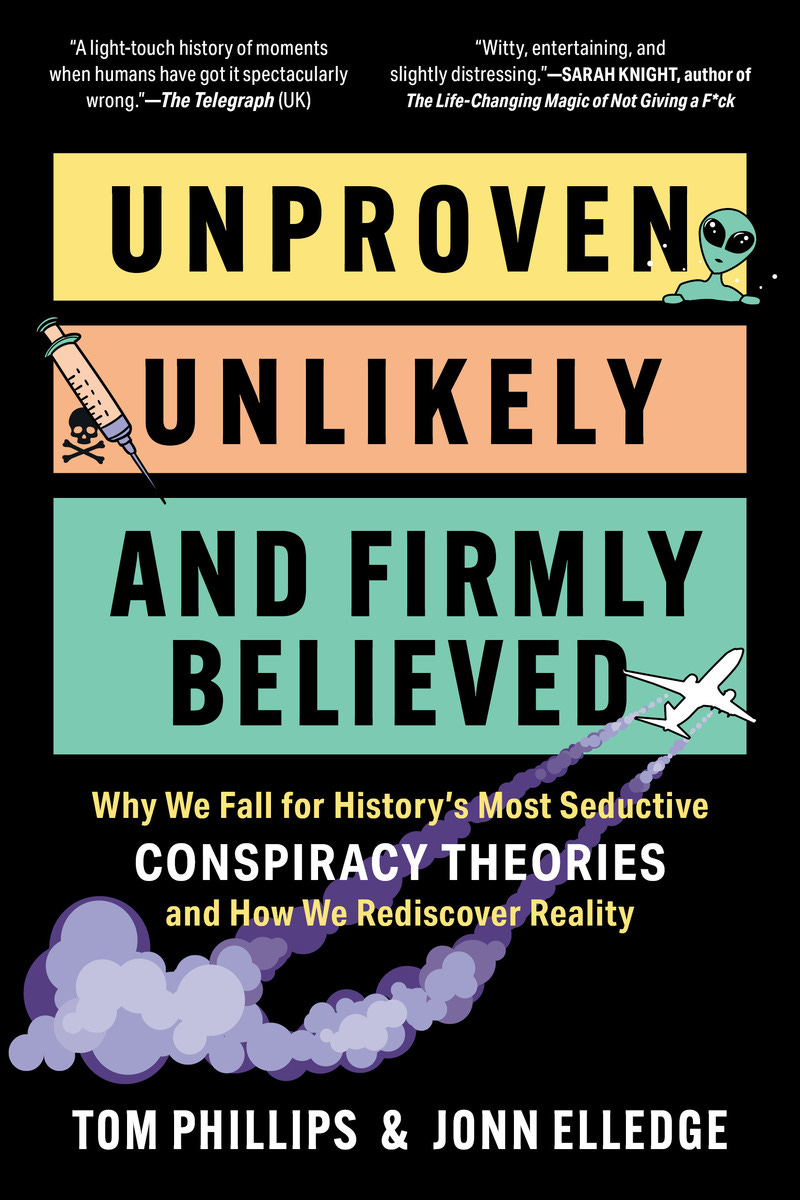
So for Unproven, Unlikely, and Firmly Believed, the sinister Tom Phillips and I essentially completely rewrote the beginning, the end and also frankly some chapters in the middle (covid). Since I’m away this week1, and since I feel a bit bad that many of you were kind enough to buy copies of a book that’s now out of date, I thought this week I’d publish some of it here. What follows is the new introduction, written to reflect the fact that – in those halcyon days of 2021 – we didn’t imagine that the conspiracists who’d just tried to overthrow a presidential election result would somehow find their way back to the White House. North American readers can buy the book, should you wish, from Barnes & Noble, Amazon or the Grass Roots Bookstore.
You know the scene. You’ve probably seen it a hundred times now, from a dozen different angles. You might be sick of seeing it.
A man stands behind the desk of the Vice President in the United States Senate, leading the chamber in prayer. There are subtle visual clues that something here isn’t right. The man is speaking through a bullhorn and is armed with a spear, to which he’s attached a US flag. His face is covered with red, white and blue paint, and his chest with tattoos inspired by Norse mythology – which are visible because he’s naked from the waist up, except for a furry hat with horns. Yes, something is definitely wrong. That’s supposed to be where Mike Pence sits. That’s not Mike Pence. Mike Pence doesn’t dress like that.2
That scene took place on January 6, 2021 – and even though years have passed and every second of that day’s events have been endlessly scrutinized, there remain two competing interpretations of it that are entirely incompatible. One is that when several thousand protestors descended on the Capitol building, they did so peacefully, to prevent a cabal of traitors from stealing the previous November’s election. Armed with nothing but the purest love of American democracy, they came with but one intent: to prevent the confirmation of a fraud as the nation’s 46th President, and to defend the rightful occupant of that office, Donald J. Trump.
The other, incompatible interpretation of these events is that January 6, 2021, was a day on which several thousand thugs invaded the Capitol in a naked attempt to overturn a democratic election of which they didn’t like the result. To intimidate Congress – not just their opponents, but their allies, too – they brought violence into the very heart of American democracy. And some of them dressed like assholes to do it.
The interpretation that you think is correct will be determined by whose side you are on, and which information environment you live in. (To be absolutely clear about where we’re coming from here: it’s the second one. It is absolutely the second one.)
In his remarks on the Ellipse earlier that day, President Trump had encouraged his followers to make the journey and ’peacefully and patriotically make [their] voices heard’. Sure. Why not. Helpfully, though, he’d also suggested they ’fight like hell’ – and some of those who invaded Congress that day seemed rather more into the ’fight like hell’ bit than the ’peacefully make their voices heard’ of it all. One of them came armed with eleven Molotov cocktails. Out on the Mall, mock wooden gallows had been erected, to cries of ’Hang Mike Pence!’ Over the course of the day, multiple journalists covering the protest were attacked, and fifteen police officers were hospitalized. One of the rioters, a thirty-five-year-old former US Air Force officer named Ashli Babbitt, was shot in the shoulder while attempting to break through a door in the Capitol, and died from her wounds. An officer assigned to protect the Senate, fifty-one-year-old Howard Liebengood, died by suicide several days later.
As the world watched agog, on live TV, a mob tried to overturn the results of an American election – even as many of them remained convinced they were trying to save it.
In their immediate goal of course, they failed. Joe Biden was confirmed; Mike Pence was not hanged. Delaying the process until the next day didn’t have the effect that they expected, because counting electoral college votes is not a magical ceremony that only works if you do it at exactly the right time. American democracy got another four-year lease. But the forces that brought the rioters there – the forces that had been brewing for a long time, the forces that fueled their anger, their distrust and their fundamental misunderstanding of American constitutional procedure – did not go away.
The January 6 rioters were brought to that point by a conspiracy theory – or, more accurately, by a large number of conspiracy theories, most of them false and one of them basically true.
The main false theory was most pithily expressed by President Trump on November 4, the morning of the election. ’We are up BIG,’ he tweeted, with his customary commitment to the shift key, ’but they are trying to STEAL the Election.’ This was perhaps not surprising, coming from a man who in 2016 had insisted that an election he’d won had been rigged against him – at that time based entirely on claims from a random guy on Twitter who said he’d discovered 3 million fraudulent ballots, enough to hand Trump a popular vote win. You’ll be amazed to learn the Twitter guy never produced the evidence he promised.
Four years later, there were a lot more theories about exactly how the Democrats planned to ’STEAL the Election’, most of which . . . didn’t really fit together. Bags of ballots had been thrown out, it was claimed, or suitcases of fresh ones mysteriously found. Mail-in votes were supposedly rife with fraud. Illegal immigrants and dead people were said to have voted in droves. Many claimed rigged voting machines had fiendishly switched Trump votes to Biden ones. Six months after the election, a spurious ’audit’ in Arizona was still microscopically scanning ballot papers for traces of bamboo, in an effort to prove they’d been shipped from China. (That the allegations mostly centered on major urban areas with large non-white populations – despite the fact that Trump largely increased his vote share in these places, while losing in the suburbs – provided a subtle hint about what was fuelling many of these claims.)
One especially prolific source of fraud claims was a Texas activist named Gregg Phillips – the very same random Twitter guy who’d supplied Trump’s ’3 million illegal voters’ claim back in 2016. Phillips supplied the core research for 2000 Mules, a ’documentary’ that claimed to prove organized ballot-harvesting through cellphone location data. The film’s claims were quickly and thoroughly debunked, and Phillips’s own organization again failed to produce its evidence, admitting it didn’t even know the identity of a person they’d claimed as a ’whistleblower’.
And why were the Democrats stealing the election? The answers here ranged from your basic hunger for power, to Marxist takeovers, to the belief that the President had been fighting a one-man war against a Deep State cabal of cannibalistic, Satan-worshipping pedophiles, possibly operating out of a pizza restaurant basement, and definitely somehow connected to Jeffrey Epstein, and that they needed to rig the election to avoid their imminent date with justice. This last idea stemmed from QAnon, the sprawling conspiracy theory based largely on a series of anonymous messages on the troll-infested message boards, to which Jacob Chansley – the guy in the horned hat – had subscribed.
At any rate, conservative America’s fears about the election, nurtured by decades of overstated or baseless claims of electoral fraud, had been brought to the boil by months of assertions from President Trump that the Democrats were trying to steal the win. (This was, after all, a man who four years earlier had insisted that an election he’d won had been rigged against him.) This was amplified by the widely anticipated ’blue shift’ during the night of the election, as the running count began to include different types of votes from different types of area. None of this was unexpected. But if you were the sort of person who simply couldn’t conceive of how the President could lose – which, it turned out, a significant minority of Americans were – it all looked pretty suspicious. A poll in May 2021 found that a majority of Republicans believed the election had been rigged, that Donald Trump was still the true President, and that the Capitol riot was led by left-wing protestors trying to make Trump look bad.
The thing is, there was fairly compelling evidence that somebody was conspiring to steal the 2020 Presidential election: the guy who lost. That the Trump camp had planned to declare premature victory and cast doubt on the election – whatever the result and whatever the evidence – had been reported well before election day. In the aftermath, the President openly discussed his expectation that the Republican majority in the Supreme Court would help hand him victory; in addition, his campaign and sundry hangers-on had filed over sixty separate lawsuits in an attempt to overturn the vote in various states, while state election officials were pressured, sometimes directly by the President himself. It all culminated in early January, with the novel legal theory that the Vice President – the real one, not the guy in the furry hat – had the power to unilaterally reject the election outcome and declare himself still the Vice President. We know this part because, helpfully, they wrote the plan down, in clear violation of the rule about whether you should take notes on a conspiracy.
So, that was the true conspiracy theory – the one about a real conspiracy that relied on a slew of other conspiracy theories, which would end up with over 400 people being charged with federal crimes and a man with no shirt leading the prayers in the United States Senate.
Several things are worth bearing in mind about this story in the pages to come. One is that the Trump camp’s conspiracy theories – whether they genuinely believed them or not – look surprisingly like the real conspiracy between the President and his fellow travelers. Another is that conspiracy thinking, so long dismissed by much of the culture as the preserve of outsiders, weirdos and the generally disenfranchised, was being propagated by the actual President of the United States.
The third is that conspiracy theories have real consequences. People died, and for the first time in its history – which included one election held during the actual Civil War – the United States failed to have a completely peaceful transfer of power.
And of course, there’s a fourth thing that’s inescapable – the reason why January 6, 2021, will go down as a watershed in US history, even though it didn’t work – which is that none of this was enough to prevent Donald Trump from winning 31 states, 312 electoral college votes and thus the White House again four years later. The man who built a political career on indulging in conspiracy theories ever since he questioned the true origins of the Hawaiian-born Barack Obama would be far more explicit in his embrace of them in his second term – not merely indulging in conspiracy theories, but building an administration on them. His FBI director, his Director of National Intelligence and his Secretary of Health and Human Services were all active believers in conspiracy theories that ranged from election fraud to vaccine plots.
Oh, and remember Gregg Phillips, the random Twitter guy behind those baseless election fraud claims in both 2016 and 2020? He was put in charge of disaster response at FEMA. He has no experience in disaster response.
In 2021, the events of January 6 seemed to many like a shocking aberration, a dark undercurrent of society briefly bursting its banks and flooding into the heart of American democracy. Four years later, it was the governing ideology.
All of which raises the question: how the hell did we get here?
There’s no doubt that the conspiracy theories that helped drive the Capitol insurrection were a product of the modern age, born in the fever swamps of 4chan, popularized through YouTube and Facebook, and spearheaded by a President who ruled by tweet and got his intelligence from cable news. Social media has made it easier to propagate theories, while algorithms designed to keep people clicking or watching videos have doubled as conveyor belts to pull people towards more radical viral content. (And all of that was before generative AI arrived and flooded the internet with deepfakes.)
But while Donald Trump may be the most famous head of government to use and spread conspiracy theories to achieve his goals, the recent history of Viktor Orbán’s Hungary or Jair Bolsonaro’s Brazil are a reminder that Trump is hardly unique. And all this was true even before the Covid-19 pandemic kicked off, and we all had to come to terms with the fact that a bat in central China had coughed and millions had died as a result (with the rest of us stuck inside for over a year and left unexpectedly celibate, unemployed or simply getting really into sourdough).
If it sometimes feels like we are living through an unprecedented period of paranoia, it’s important to remember that conspiracy theories have a very, very long history. They were present in the politics of Ancient Athens and Rome. And while many historical conspiracy theories have been lost in the mists of time, some have endured: as we’ll see, many of the theories that motivated the movement that descended on the Capitol that day have lineages that can be traced back centuries.
Indeed, the very American democracy that was threatened by conspiracy theories that day in January 2021 was originally founded on conspiratorial thinking. Several historians argue that the Declaration of Independence – with its dark warnings of covert British plans for imminent tyranny, and its long list of supposed ’abuses and usurpations’ – didn’t so much include a conspiracy theory as it, in itself, was a conspiracy theory. Conspiracy theories may be having A Moment right now, but that doesn’t mean they are new.
These theories rarely spring from nowhere. Very often, they’re adapted from earlier versions, updated and adjusted to fit new social contexts. Sometimes the villains, whether individuals or institutions or entire ethnic or religious groups, change over time. Sometimes – as many Jewish people who have tried living in Europe over the last thousand years or so could probably tell you – they do not.
The stereotype of conspiracy theories often says that they’re something that the masses believe about society’s elites – a backlash of the powerless against the powerful. And sometimes that’s true. But, as the events of the last few years have done so much to remind us, conspiracy theories are often spawned and spread by elites themselves. The patronizing view that they’re the sole preserve of the left-behind, the under-educated and the ill-informed couldn’t be further from the truth. Among the conspiracy believers we’ll meet in this book are monarchs and political leaders, lawyers and businessmen, mathematicians and chemists, eminent physicists and pioneering inventors. There are plenty of military officers, and a fair few priests. There’s one Nobel laureate who’d feature on any decent list of ’smartest people of the twentieth century’.
And none of us – whether we’re on the political left, right or center – are immune from believing in conspiracy theories. Our brains are built to see patterns in the world, and do it so well that they sometimes see patterns where none exist. At the same time, our world is often shaped in profound ways by unseen forces that can seem like the product of conscious design – from social change to patterns of disease to the effects of the market.
Many of these forces are, as Adam Smith wrote in The Wealth of Nations in 1776, ’not originally the effect of any human wisdom’, but simply a ’consequence of a certain propensity in human nature.’ All our lives, we’re constantly pushed, pulled and prodded by invisible hands. Is it really surprising that, sometimes, we imagine those hands must be attached to somebody? Conspiracy theories allow us to put a face to those forces, to give a name to the most primal fears and deepest anxieties that haunt us. They give us someone to blame.
There’s one other thing it’s worth stating outright before we get too far into the weeds here: sometimes, conspiracy theories are true.
Sure, we can be pretty confident that the Earth is a globe, that the ’chemtrails’ left behind by planes are harmless condensation, not some kind of bioweapon, and that Bill Gates has not been using vaccination programs to turn humanity into his personal slave army. But in 1956, the British and French governments really did secretly coordinate an Israeli invasion of Egypt, so they could march in as peace-keepers and take control of the Suez Canal. The US Department of Defense really did draw up (though didn’t carry out) plans to commit terrorist attacks on US soil as a false flag operation. And the US Public Health Service and the Centers for Disease Control and Prevention really did leave several hundred African American men with untreated syphilis for decades while telling them they were healthy, just to see what would happen. You could write a whole other book just on the conspiracies that may once have been dismissed as crazy talk, but turned out to be absolutely real.
Just because you’re paranoid, that doesn’t mean they’re not out to get you. They’re just probably not.3
So, if we’re going to understand the role that conspiracy theories play in our societies – how they affect our politics, our culture, and how they can draw our loved ones down obsessive rabbit holes – we need to understand their history. We need to understand where conspiracy theories come from, why people believe them, why they’re more likely to pop up in some circumstances than others, and what it is about our brains that makes us prone to believing them.
In the first part of this book, we’ll dive into the theory behind the theories: what is a conspiracy theory, what are the different types, and why do our brains seem irresistibly attracted to them?
Then we’ll look at the history of conspiracy theories that try to explain specific events – from revolutions to assassinations, from UFOs to pandemics – many of which teeter on the boundary between the implausible and the all-too-plausible.
After that, we’ll look at the theories that expand their scope and, in doing so, become increasingly detached from reality. These are the ones that suggest that our world is not as we know it, that global events have been maliciously engineered, and that everything is controlled by shadowy groups, who may be the Illuminati or possibly aliens. We’ll see how these have developed over history – and confront the possibility that history itself may be a lie.
We’ll finish back in the present day, as we return to look at our modern age of conspiracies – and, finally, we’ll suggest some helpful tips on how to live in a world in which conspiracy theories seem ubiquitous. How can you avoid falling down the rabbit hole yourself? How can you tell the difference between a bullshit theory and an actual conspiracy? And is there any way to fight back?
There are a lot of conspiracy theories in this book. Sometimes they link up; often they don’t. And the further in we get, the more we’ll find that people have found ways of connecting them all the same. Along the way, we’ll see both how conspiracy theories have helped create the world we live in, and how they often reflect our societies and ourselves back at us. We’ll learn that the Illuminati really did want to change the world in secret, but that this wasn’t as scary as it sounds, and anyway they weren’t very good at it. We’ll see that, sometimes, conspiracies spring from nothing more than the excitement of deciding that everything you know is wrong.
We’ll discover that many of them are weird; some are funny; others are terrifying. And we’ll find that none of us is immune from believing them.
But first, we need to ask: what exactly are they?
To find out, you’ll need to buy the book – from Barnes & Noble, Amazon, the Grass Roots Bookstore. or direct from The Experiment. (The original unupdated British version is still available too.) I’ll be back next week with your regular newsletter service.
That was an excerpt from Unproven, Unlikely, and Firmly Believed: Why We Fall for History’s Most Seductive Conspiracy Theories, and How We Rediscover Reality © 2022, 2026 by Jonn Elledge and Tom Phillips. Available everywhere books are sold.
In Portugal, with family, for a much loved uncle’s landmark birthday. (Two weeks off? In one summer? The decadence of it.)
At least, he didn’t in 2021. We’ll be honest, we haven’t really checked in on what Mike Pence is wearing these days.
But they might be.
It’s a great wee book. I enjoyed the audiobook version.
Goodness. A forensic analysis which shows me how little we actually hear down under about the extent of the conspiracy stuff in the USA. I think we sort of read the headlines and have a bit of a laugh then go about our day. Can't alter it, don't want it bleeding into our lives. But as you point out, people died, and Americans went on to elect the nightmare that is Trump. I hate it that they don't get off their couch. "Oh it's not my fault, I didn't vote". Pffft. Will never understand that. Hope you're staying cool!!