The Frog and the Bin
Nigel Farage is losing his touch, ha ha ha ha ha. Also this week: some notes on the nationhood of Portugal; and some gratuitous Americanisations.

There was a moment yesterday when it felt like he’d done it again. Nigel Farage has had a terrible couple of weeks, giving a series of interviews in which he’s struggled to contain his outrage at being asked about his finances, and appearing genuinely aggressive towards some poor Sky reporter. Since he clearly wasn’t enjoying the increased scrutiny, and since being prime minister would require a quite substantial pay cut, speculation was rife that his unexpected 2pm speech might mean he was about to – at least temporarily – depart the stage.
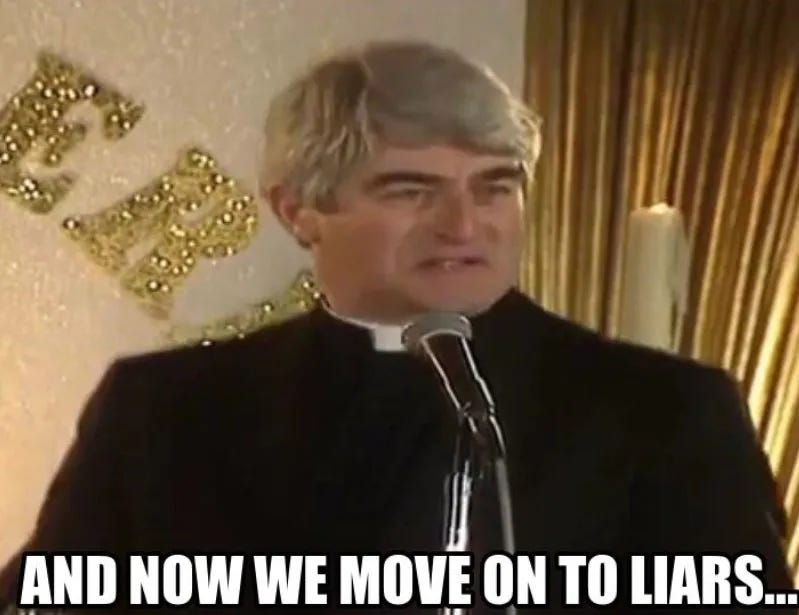
But as the rambling whinge-a-thon entered its third decade in a manner distinctly reminiscent of Father Ted accepting the Golden Cleric award, it began to dawn on us that the media had once again been played. BBC News had abandoned its regular programming to broadcast an unedited Reform broadcast live; the large chunks of the lobby currently at the NATO summit in Ankara had ceased engaging with the small matter of the defence of Europe to tune in; the podcasters were gearing up for emergency broadcasts. (Ours is here, by the way.)
And what we were all talking about was no longer the rolling financial scandals, but a new story Farage had served up on a plate: an unnecessary by-election, which he would almost certainly win, and which was now all we’d be discussing all summer, thus depriving Andy Burnham’s Downing Street of headlines in its crucial early weeks. This was the sort of move Donald Trump would pull, changing the story by simply chucking out something new. The reactionary content industrial complex had struck again.
But just as Farage seems to have lost both his instinctive sense of exactly what the British electorate will bear and his infuriatingly effective air of bonhomie, so he seems to have shed his ability to reshape British politics around himself. The LibDems, who were never likely to be a factor in any Clacton by-election anyway, announced they weren’t playing and would not be fielding a candidate. So, with greater potential effect on the result, did the even more furious Reform tribute act Restore.
Labour, the Tories, the Greens – all soon fell into line. By bedtime it had become clear that Farage’s attempt to get himself tried by a higher court than the parliamentary authorities by effectively calling a referendum on himself was actually on course to be a straight fight between him and a comic with a bin on his head.
From here, there’s no possible outcome that will not be cripplingly embarrassing for the Reform leader. Most likely he holds his seat, without being able to claim any mandate from it; but there’s a slim chance he’s beaten by Count Binface, a moment from which there can surely be no return. And if he cancels his resignation now, it amounts to admitting he’s a coward who’s just wasted everyone’s time. His best outcome would probably, ironically, the one the LibDems were pushing: that the government should decline his permission to resign at all, thus allowing him to claim establishment stitch up yet again. Alas for Nigel, Chancellor Rachel Reeves, to whom the decision bafflingly falls, posted earlier that, if he wants to spend his summer “arguing with a bin”, she would not stand in his way
Even if his strategy had worked, it would not have solved the fundamental problem: parliamentary investigations are not invalidated simply because you call a by-election. He’s mistaken a regulatory problem for a political one.
Nigel Farage, of course, is a political cockroach, a man who’s survived results and scandals that would have nuked most political careers to smithereens. Many of his supporters, I’m sure, couldn’t care less about the sources of his money, or what any boring regulator has to say about it.
But at least some of the voters required to take his party to 30% surely will. And anyway, something bigger has shifted. He built his profile by being both available to and cheerful towards the cameras. But the British media, a shallow bunch as ever, don’t respond well to those who treat them with contempt.1
And laughter is harder to survive than any scandal.
What the hell’s going on with my breathing, and other questions
Interrupting your actual content with a quick note that the audiobook of A History of the World in 47 Borders is currently in some kind of sale – so if you want me to talk history at you for 10 hours while sounding like I’ve just climbed a big hill then now’s your chance.
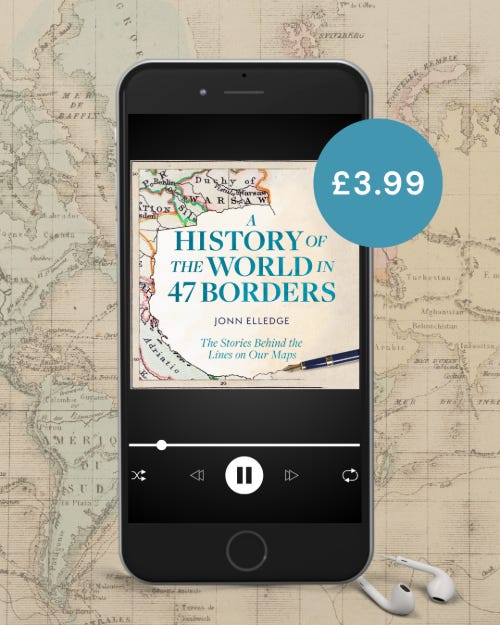
Also, thanks to everyone who’s ordered the new one, pre-orders have a disproportionate effect by telling bookshops they should pay attention, yada yada yada.
And now, back to the show.
On the nationhood of Portugal
Were I braver, I’d have headlined this section with the question my mother asked me a few days ago during a lovely family trip to that extremely fine country: “So, why isn’t Portugal a part of Spain?” You know about borders, runs the extremely subtle subtext. Explain that one.
And it is, in some ways, a good question. The two countries share the Iberian peninsula, which is clearly a distinct geographical unit, and there’s no obvious physical barrier to divide them in the way the Pyrenees separate Spain from France. There are cultural similarities between the two countries too, not least their closely related languages: not only are both descended from Latin, but speakers of one can generally read stuff written in the other.2
All of which means it’s not immediately obvious why it was that, when the region’s various medieval kingdoms combined to form the global superpower of the 16th century, Portugal was not among them. Why did the Spanish Habburgs never complete the jigsaw?
The reason I did not use that obvious headline, though, is because the most cursory of searches will make clear it’s a question that angers the Portuguese, even though – perhaps because – it’s asked rather a lot. Consider the responses to a Quora post asking “When and why did Spain and Portugal separate into two distinct nations?” “To diverge they needed to be the same to start with,” reads the most popular reply. “I’ve replied to this question so many times I’ll soon be asking those who do so to read previous replies,” begins another.
Fair enough: ask a Canadian why they’re not American, or someone from Dublin why they don’t consider themselves British, and the response is likely to be a whole lot less polite than that. The story of how Portugal came to be a proudly independent country, though, tells us much about both the contingency of national identities, and their enduring power, so let’s have at it.
Portugal is not one of those nations that can trace its existence back to ancient times. The Romans divided Hispania, as they called the peninsula, into anything from two to four provinces, depending on which century they were living in; these, though, never mapped onto Portugal and Spain in any obvious sense. Following the fall of the western empire in the 5th century, the region was divided between Visigoths, Suevi, and a toehold for the eastern empire on the Mediterranean coasts. A couple of centuries after that, the Umayyad Caliphate conquered not quite all of it for Islam, and renamed it Al-Anadlus. At every stage of this story, Iberia was divided. At none of them was one of those divisions Portugal.
