“The war system cannot be allowed to disappear”: the report that shocked America
An extract from Ghosts of Iron Mountain, by Phil Tinline.


Jonn here. Today’s book extract comes from Phil Tinline’s fascinating Ghost of Iron Mountain, one of the Times’ history books of 2025. It concerns… well. You’ll see.
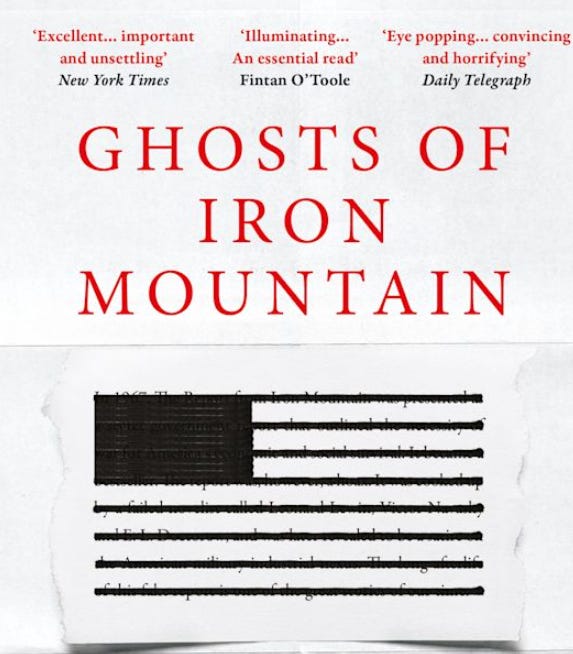
America, winter, 1966. Nearly four hundred thousand soldiers in Vietnam. Underground bomb tests in the desert. The Monkees’ ‘I’m a Believer’ at number one.
In his apartment on Riverside Drive, on the cold edge of Manhattan, a downcast, middle-aged writer named Leonard Lewin is agonizing over whether he should just give up and go back to Indianapolis. After years stuck working in his late father’s sugar refinery, he has finally escaped to New York to make a living as a writer. But here he is, deep in middle age, worrying that he is a failure with nothing to say. He wants to be remembered “for good reasons”, but cannot find a big project to sink his teeth into.
Then he gets a call. It’s an old contact, a social sciences professor from back in the Midwest, whom Lewin hasn’t heard from for years. The professor is in New York and wants to meet. Urgently.
Over lunch the next day, in a restaurant in midtown, the professor is on edge; finally, he spills the beans. Just over three years ago, in early August 1963, he was contacted by an anonymous man in Washington, who told him that he’d been chosen to serve on a commission “of the highest importance”. The idea was initiated by Defense Secretary Robert McNamara and like minds in the Kennedy administration. Its task was “to determine, accurately and realistically, the nature of the problems that would confront the United States if and when a condition of ‘permanent peace’ should arrive”. Having done so, the “Special Study Group” would have to “draft a program for dealing with this contingency”.
The professor tells Lewin that he felt he had no choice but to sign up. For one thing, the man from Washington seemed to know a troubling amount about his personal life.
In the mid-1960s, this kind of mind-bogglingly ambitious project is fairly standard. This is the high noon of Cold War think tanks like the RAND Corporation and the Hudson Institute. The vast expansion of American wealth and power since 1945 means the nation has grave dilemmas to think through, and plenty of money to pay people to do that – but these attempts to answer huge, unfathomable questions with remorseless logic can sometimes produce strange effects on how people think.
Nothing encapsulates the question of what America should do with its military might more sharply than the Bomb. And no one has been thinking this through with more gusto than a man named Herman Kahn, a RAND Corporation physicist-turned-systems-analyst who exploded into American minds in 1960. In a book called On Thermonuclear War, Kahn explained that, approached coolly and rationally, nuclear war was not unthinkable. He’d thought about it, and it could be fought, and won. Even if the bedraggled remnants of America had to survive for a time in bunkers deep underground.
Ever since, Kahn has been denounced as callous. He has been lampooned as a crazed scientist – he was one of the inspirations for Dr Strangelove, the satirical 1964 movie about how the power elite might accidentally let lunatics blow up the world. He has even been compared to the Nazi bureaucrat Adolf Eichmann. How could any decent person calmly discuss the destruction of tens of millions of their fellow human beings? Kahn defends himself by insisting that someone has to think through the real implications of a nuclear war: would people who accuse him of “icy rationality” prefer “a warm, human error”? Is it not worth trying “to reduce casualties from, say, 100 million to 50 million Americans”? But to many, this is what the radical sociologist C. Wright Mills had condemned as “crackpot realism”. You cannot have a “value-free” discussion about mass killing, and trying to do so just winds up rationalising slaughter, as Vietnam shows.
There is another criticism, too: the ‘unthinkable’ notions Kahn is thinking about are not just intolerable, but unknowable. How can he and his colleagues be ‘realistic’ about how nuclear war might unfold when they have no precedents to draw on? Computer modelling can only take them so far. They have to use their imagination. One way they do so is through ‘war games’: a fusion of computing and theatre, in which generals and officials get to act out high- stakes scenarios. But these are a form of fiction, neater and cleaner than any real crisis.
By 1966, Kahn has left RAND and set up a new think tank – the Hudson Institute, based in Croton-on-Hudson, in upstate New York. And he has expanded his methods beyond nuclear war, hoovering up more and more government contracts. However much he has spooked the public about how those in government think, Kahn’s imaginative capacities are still highly valued by those same people.
The professor tells Lewin how the Group first met at a resonant location: Iron Mountain, about a hundred miles north of Manhattan. This is one of the vast underground vaults to which members of the power elite – in this case, company executives – will flee in the event of nuclear war. The professor discovered that the Group included an industrialist, scientists, a systems analyst, and a war planner. But most of his new colleagues were, like him, from the social sciences: an economist, a sociologist, a cultural anthropologist, a psychologist, a psychiatrist. Many of these men – they were, of course, all men – had worked with government before. Some were “very well known”. This is the kind of co-opting of supposedly independent experts to which the New Left objects. The radical magazine Ramparts has recently exposed how academics at Michigan State University spent years secretly collaborating with the CIA.
The Group met around once a month for three years, all over the United States, before returning for a final session to Iron Mountain. But when they submitted their final report, it was judged too shocking for public consumption. Like that earlier study by a Senate subcommittee, it has been suppressed.
And that is why the professor has come to see Lewin. He stands by the Study Group’s findings, and after ‘months of agonizing’, he has finally decided that its report must be published, and wants Lewin’s help making that happen. The public has a right to know what is “being done on its behalf “.
When he reads the report, Lewin sees why it has been buried. The Group was charged with following its analysis, without moral or cultural value assumptions, right through to its logical conclusions. And those conclusions leave Lewin horrified. He agrees to try to find a publisher.
Meanwhile, he persuades the professor to record a series of interviews. On the tapes, the professor reveals that the Group’s assessment is that war is “the essential economic stabilizer of modern societies”, allowing for the disposal of surpluses, the generation of demand, the boosting of growth. This is why, when there is news of possible peace, the stock market tends to fall. But the Group’s fundamental insight goes well beyond this. War, it concludes, has a much wider range of uses than all those “disarmament scenarios and reconversion plans” have identified. It is not just economically useful, or strategically necessary: it is “the basic social system”.
The report’s analysis explains a lot of things that seem strange about Cold War America, from the “unnecessary” size and power of the world war industry, to the way military institutions are exempted from normal standards – and why the state sometimes has to effectively invent threats and conflicts. Without war, the Group’s report explains, there is no real basis for national sovereignty. Major military threats are vital for fostering “allegiance to a society and its values”. The need to be ready to resist attack, and the state’s capacity to protect the population, is basic to its “right to rule”, and this – not least in late-1960s America – has domestic applications. As the report has it: “On a day-to-day basis, [state authority] is represented by the institution of police, armed organizations charged expressly with dealing with ‘internal enemies’ in a military manner.”
Military service itself underpins political stability by giving “antisocial elements” a role, especially in periods of upheaval when they might be attracted to fascism. The evidence even suggests that the focus on war allows states to maintain the class system, including the incentives instilled by continuing poverty. And that war keeps the population level under control. On top of all that, it has done much to spur scientific advances. Were war to end, the change would disrupt all these processes and a range of substitute functions would be required.
This, the report warns, will not be straightforward. Diverting spending to healthcare, education, housing, and infrastructure projects would simply not use up enough of the surplus that war currently absorbs. This would actually worsen over time, as the population’s improving health would steadily reduce the costs involved. Converting the army into a “giant military Peace Corps” wouldn’t work. The report maintains that one purpose of war is to stabilize America’s booming economy by ridding it of excess wealth; turning the army into a huge international welfare programme would not achieve that, because the money would find its way back into the normal economy. The space programme might provide a more sustainable alternative drain on excess resources.
Politically, to sustain the public’s acceptance of its leaders’ “political authority”, the threat of nuclear attack would have to be replaced by a similar threat to human survival, such as “massive global environmental pollution”, but this is advancing too slowly – and deliberately accelerating it is unlikely to be “politically acceptable”. It may be necessary to “invent a threat to prevent peace [from] causing social disintegration”. This, however, is not easy. “Experiments have been proposed to test the credibility of an out-of-our-world invasion threat,” but this idea seems unworkable too.
If hundreds of thousands of young men are suddenly released from the armed forces, it could trigger serious disorder. Logically, therefore, the state might instead need to convert the “code of military discipline” into what would effectively be a “sophisticated form of slavery”, adapted to “advanced forms of social organization”, perhaps beginning with the introduction of military service for all. As for alternative ways to channel all that young male aggression, the report notes that “Games theorists have suggested, in other contexts, the development of ‘blood games’” as a method of controlling this. Without the role of war in reducing population levels, it might in theory be beneficial to introduce eugenic artificial insemination.
Much of which might sound crazy, but in the think tank world of game theory and scenario planning, doubtless another such study group has come up with worse. Having followed its logic to all these alarming conclusions, as instructed, the Group concludes that “no program or combination of programs yet proposed for a transition to peace has remotely approached meeting the comprehensive functional requirements of a world without war”. On that basis, “the war system cannot responsibly be allowed to disappear until ... we know exactly what it is we plan to put in its place.”
It does not take Lewin long to find a publisher. The Dial Press is upmarket and adventurous, a Third Avenue publisher favoured by radical, taboo-breaking literary superstars like James Baldwin, author of The Fire Next Time, and Norman Mailer, author of Why Are We In Vietnam? In autumn 1967, in its new non-fiction list, Dial announces a volume called Report from Iron Mountain on the Possibility and Desirability of Peace, with an introduction by Leonard C. Lewin, and waits for the media to respond. Or most of the media. The book has already grabbed the attention – and the spending power – of one of the biggest, brashest, smartest magazines around.
A few blocks uptown and west from Dial’s office, in a skyscraper on Madison Avenue, lies the headquarters of what the Sunday Times calls one of “the world’s great magazines”. In 1967, Esquire rules, and not just for splashing succulent Hollywood colour into a print world full of black and white. Its circulation has topped 1 million; in 1966, its advertising revenue leapt 25%. Esquire’s superstar editor is a man named Harold Hayes – a North Carolina geek sharpened up by military service, Harvard, and years of fighting with colleagues to win the editorship. From his curved-glass corner office, he’s thrown off the caution of the 1950s and now comes at things from surprising, jarring, irreverent new angles. He commissions diagrams charting America’s power networks – which might look like a conspiracist’s pin board if they weren’t so obviously provocative. When the president was shot, he ran a piece called “Kennedy Without Tears”. He sent reporters to follow Marines into battle in Vietnam, and turned the whole cover black, save for a quote in white from a soldier: “Oh my God – we hit a little girl.”
Hayes’ leadership has helped produce something that will come to be called the ‘New Journalism’. An Esquire writer doesn’t hack out a story; he (it’s nearly always he) composes it with the care and flair of a novelist. Not least because that’s what a lot of them are. James Baldwin writes about Norman Mailer; Norman Mailer writes about John F. Kennedy. Tom Wolfe hangs out with Cassius Clay (the future Muhammad Ali). Gay Talese chases Frank Sinatra. Two of Hayes’ staffers have written the year’s totemic movie, transfiguring a sordid old news story about shambolic Depression gangsters into Bonnie and Clyde: an achingly hip, generation-dividing celebration of fighting authority with guns.
Esquire’s December issue is the most important of the year, packed with twice the ads. Given the clunky technology of the day, it has to be done in August. This year, not for the first time, Hayes has a Christmas bomb to set off for his million readers, to shake them up, and to make them think about the impact of war. Alongside a piece by Candice Bergen on the burning of the old order, and an image of film star Sharon Tate seductively eating a pear, Hayes has decided to run what he proclaims “an important piece”: a condensed version of Report from Iron Mountain. Condensed, as in fully 20,000 of the Report’s 28,000 words.
In Washington, meanwhile, rumours of a suppressed report have been coursing through government circles, triggering “a severe case of jitters”. Journalists are picking up talk that it will “soon see the light of day and shock the nation”. One official passes the galley proofs to the next, generating what Newsweek calls “megatons of speculation”. Can this document be real?
There’s only one way to find out: you’re going to have to buy the book. That’s no hardship: it is one of the best things I read last year, and it concerns, among other things, the military-industrial complex, conspiracy theories, America’s fear of its own power, and the relationship between centrists and radicals. You can buy it from Amazon, Waterstones, Foyles or Bloomsbury Publishing.
Phil Tinline is a journalist and historian. He is also the author of The Death of Consensus: 100 Years of British Political Nightmares, The Times Politics Book of the Year 2022.
 | A guest post by
|
???? wtf ???? the subtitle of the book spoils the authorial pose you assume in this post. Why are you doing this?