Urban Hymns
This week: some notes on the bus that thinks it’s a tram; and where is Britain’s second city anyway?

Before we begin, thanks to those of you who came to hear me talk about the new book at the Rock Oyster festival last Sunday. Apologies that, despite what certain newsletters may have suggested, early copies were not, in fact, available. Mistakes were made; it’s important not to point fingers.1
Excitingly, there is now an entire schedule of events for this autumn, at which books definitely will be available, with more dates being finalised even as I type. At some of these talks it is also likely that I will even, for logistical reasons, be accompanied by Henry Scampi – who, in the break in his campaign to befriend the entirety of Cornwall, has this week been on a boat, to a castle. If you’d like to come say hi in a bookshop convenient for you, you can check the schedule here.
What follows is another of the chapters written for the new book that, for various reasons, ended up on the cutting room floor. If you enjoyed that, and want to read another 31 essays on these sorts of topics but even better, then you should click here to preorder.
Beyond that, there are some maps, about where Britons think the second city is, plus the usual round up of links. Enjoy.
The other sort of tube network
Provided that you don’t mind comparing apples and articulated rubber-tyred oranges, you can make a compelling argument that London has fewer tube stations than the eighth-largest city in Brazil. The British capital has 272; Curitiba at least 357. Not bad for a city a barely one fifth the size.
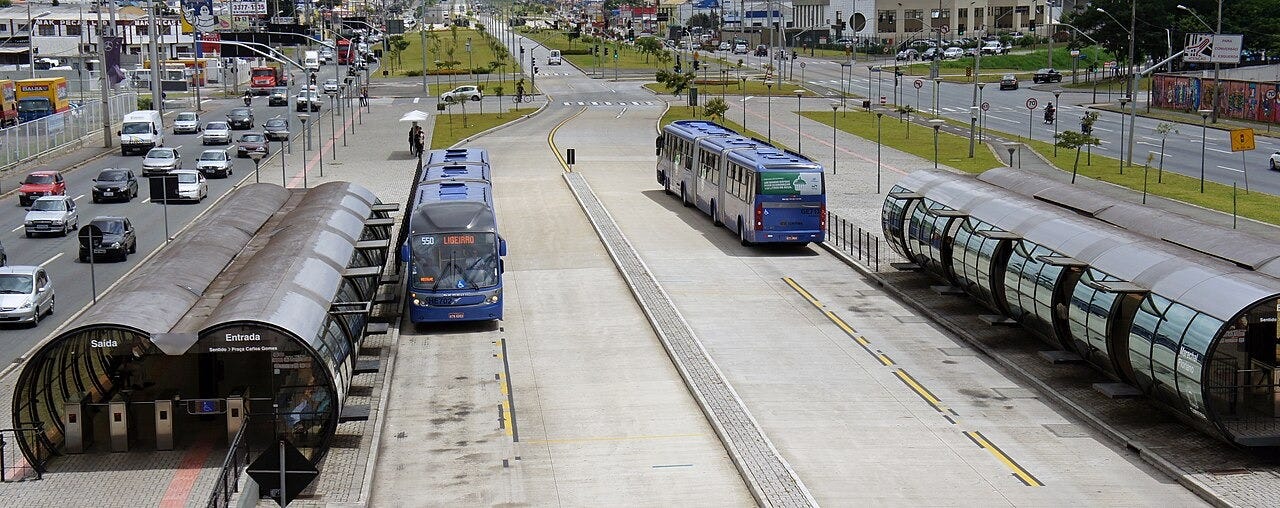
These are not, of course, the same things. Curitiba’s ‘Estação Tubo’ are rather more literal than London’s version – physical tubes of steel and glass, like something out of a work of modernist sci-fi – and are served by buses rather than trains. But they, too, are a key part of a revolutionary new transport network that changed their city and inspired others far beyond, and became an icon of the place that invented them, too. The airport gift shop is even shaped like one. That, right there, is impact.
Jaime Lerner, the father of the city’s transport network, was not an obvious candidate to change the world. In later life he’d be convicted, twice, for corruption, and would only avoid jail because of his age. He wasn’t even elected to his post as the city’s mayor, but appointed to it in 1971 by a military dictatorship that was, in the words back in 2015 of (one time CityMetric Latin America correspondent) Drew Ree, “confident that the young architect wouldn’t challenge [the] political order”. In office, though, Lerner changed everything. He radically rewrote his city’s planning policies, abandoning plans to widen the roads, and pedestrianising chunks of the city centre instead. Rather than turning drainage canals into concrete channels, he turned them into parks that doubled as flood meadows, and left them to be tended by (my favourite detail, this) sheep.
His most influential legacy, though, would be the Rede Integrada de Transporte: the Integrated Transportation Network. When Lerner took office, the expectation had been that Curitiba would follow in the footsteps of a hundred cities before it, and develop a traditional rail-based metro system like a subway. But even in a city of just half a million, he realised, this would take years and cost a fortune. A system based on buses would be cheaper, but would come with all the problems of, well the bus – most notably, getting stuck in traffic, not to mention creating it through their frequent stops. What, Lerner started to wonder, if there was a way of getting all the benefits of the metro, at the relatively low cost of the bus?
