Borderline Exhaustion
Rob Hutton on a forgotten electrical pioneer; some previously unseen thoughts on borders; and some sentences that might seem passive aggressive, if you’re gonna be like that about it.

There are several things I didn’t really understand about writing books until I’d already started doing it. One is that, look, there really are a lot of books these days and honestly, adding to that problem is an objectively silly way to spend your time. Related to that is the fact that, if you’re the sort of person who loves bookshops, as you almost certainly are if you’re trying to get your work into one, you’ve just ruined them for yourself for the rest of time. (“Where am I… nowhere? Oh. But they’ve got that prick’s book on the big table, I notice...”)
A big one, though, is: there is not in fact a moment when you ever actually finish writing a book. You finish a draft and think you’ve finished writing – except sometimes the editing is the writing, and sometimes it turns out there’s an entire thing you’ve missed.1 Then there are copy edits, fact checks, all the material like sources and acknowledgements that most readers won’t spot but which you do in fact need, the final type-set pages to check over, probably an audiobook to record... At no moment do you get the “last exam DONE” sense of release you’d think a big project like this would actually allow for.
So: grab those moments when you can, as it’s better to feel like you’ve finished a book on multiple occasions than to never feel that at all. On the new book, there is a lot of work left to do – but there are no more chapters to write, and none which I’ve written then not dared to reopen, their inevitable problems lurking like bombs waiting to go off. All have been written, and tidied, and sent in. The book is not finished, but it does, in some sense at least, exist.
And the result is I am – please forgive me – completely and utterly shattered. This feels quite self-indulgent to admit, when I do the sort of work whose social cachet vastly outweighs its actual utility, and which many people – including me, not that many years ago – would dearly love for themselves. But since the start of the year I’ve worked evenings and weekends, and had nights when I pushed on til 10, then found I couldn’t switch my brain off and end up doing my admin in front of the TV. My dopamine-seeking habit has been redirected to a ticking-things-off-a-to-do-list habit. Is this better? Ask my therapist.
All of which means this week’s newsletter is a bit of a cheat: one thing donated by a mate, whose own book you should buy; some previously unseen thoughts about borders, written for an Italian newspaper; and one silly list, to which you’re invited to add in the comments. I’m hoping to be back to fighting strength soon.
Oh – and thanks to those of you who came to see me at the Royal Geographical Society, an event I found a lot more energising than I’d expected given it was a rainy night in Portsmouth and I was tired enough to fall over. Thanks to Dr Mark Hardiman for stepping into the breach to chair, too. I enjoy this bit, and learned a lot from an audience full of people far cleverer than myself. More of that to come, I hope.
An offcut, from Rob Hutton
Here’s a footnote, from my chapter on green belts, which I know, deep down, is not making the edit on the grounds it has literally nothing to do with green belts:
‘The Time Machine’ also, accidentally, inspired the Daleks, for whose first appearance back in 1963-4 writer Terry Nation shamelessly borrowed Wells’ structure and bolted on some stuff about nuclear holocaust and Nazis.
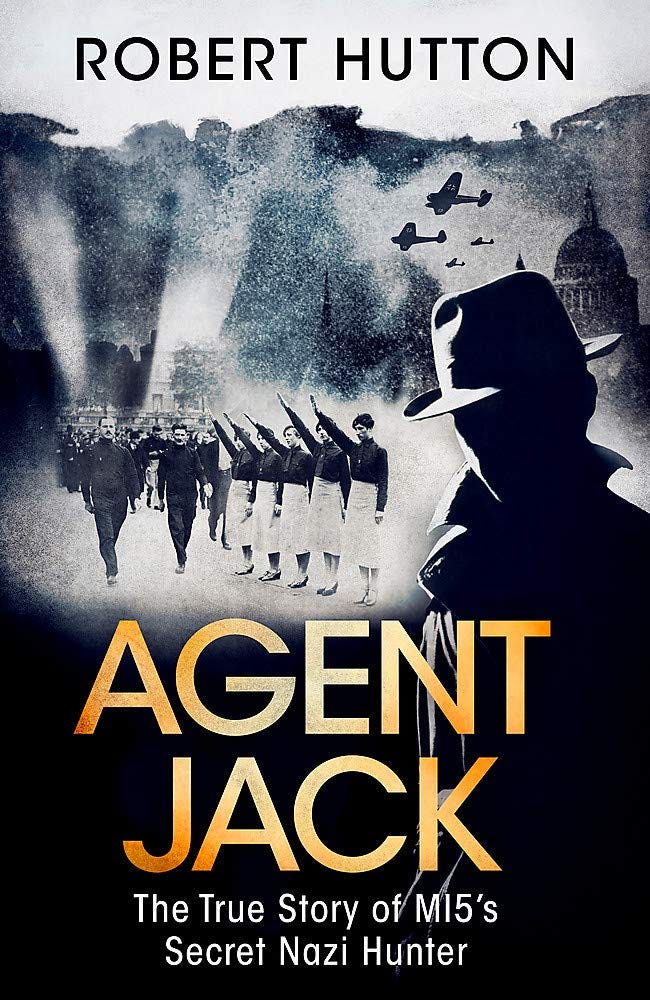
When I posted this on Bluesky2, as you do, Rob Hutton noted that he’d had to cut a bit from his book Agent Jack concerning the man who, in 1816, “dug up his garden in Hammersmith in an effort to demonstrate that electricity travels very quickly”. Why is this story not in the final text? Because Agent Jack is a fundamentally book about a bank clerk who spent the Second World War infiltrating a network of Nazi sympathizers on behalf of MI5, and thus has absolutely nothing to do with the discovery of electricity or really anything else going on in Hammersmith in 1816. Editors can be so cruel.
Anyway, telling you interesting but fundamentally irrelevant things is very much this newsletter’s schtick, and Rob very kindly said I could post the long lost paragraphs. Here they are now:
The same year that Werner Siemens was born, 1816, an inventor in London had dug up his garden. Francis Ronalds was fascinated by a new discovery, electricity, and thought that it might have practical uses. Electricity, he noted, could be “compelled to travel”. He was sure this property meant it could be used for communication. The year before, it had taken three days for news of Wellington’s victory at Waterloo to reach London. How much might electricity shorten that time? He pictured government offices the length of the country, linked by wires carrying messages that had previously been carried by horse or semaphore.
By first building huge frames next to his family home in Hammersmith, and stringing 13 kilometres of wire between them, and then digging a 160 metre trench the length of the garden and burying a cable, Ronalds demonstrated that electricity travelled almost instantly across long distances. Using dials at either end of the line, he showed that it was possible to manipulate the electricity to transmit messages. Satisfied that his invention was both useful and practical, he took it to the Royal Navy. In the best traditions of military bureaucracy, they told him his invention was “wholly unnecessary”. Disappointed, Ronalds gave up on communication, and moved to other areas of research.
“A fascinating morning’s reading, turned into two neat paragraphs that I see made it through three drafts before being cruelly cut,” Rob said, with some sadness. Why not make him happy again by buying Agent Jack today? (From Amazon, Waterstones or Barnes & Noble.) Or his other book, The Illusionist: The True Story of the Man Who Fooled Hitler? You won’t regret it.
While I’m selling books…
NORTH AMERICANS! The region 1 editions of my first two books are published in June, under the new titles Elledge’s Nontrivial Trivia and Unproven, Unlikely, and Firmly Believed. The new one’s out later this year, too.
For the next three days you can get 25% off preorders from Barnes & Noble with code PREORDER25. You know what to do.
A quick Q&A concerning maps and borders
A few weeks ago, Davide de Leo, a writer for the Italian newspaper La Repubblica, asked if I’d answer some questions about borders for its fortnightly newsletter, Storie di Storia. I ended up writing significantly longer answers than they actually needed, and making a bunch of dumb jokes I suspect don’t actually translate. Enjoy.
Could you introduce yourself very shortly?
My name is Jonn Elledge, I’m an English journalist and non-fiction writer, based in London. I’ve been writing for the left-wing political weekly the New Statesman since 2013, helping to bring down the tone at the magazine that gave the world Christopher Hitchens and George Orwell. Since 2020 I’ve also written three books, the most recent of which is A History of the World in 47 Borders. I’m working on the fourth right now. Please don’t ask me how it’s going.
What do you see in maps and borders? What makes them so attractive? Were you one of those kids who used to stare at maps of far-away countries and dream about far-away places?
