Everybody Hates Keir
How did Starmer go from landslide to endgame in under two years? Also this week: the most murderous mammal on earth; and every thought I have about an insane train plan.

Somehow, multiple things in my flat have contrived to fail at the same time – those who follow me on Instagram may have seen the hole in the bath; I’ve joined a gym, for the first time in months, just so I can take a shower.1 Anyway, none of this has been great for either my looming book deadline or my ability to think. If I’m a little less coherent than normal this week, please, cut me some slack.
If Keir Starmer ceases to be Prime Minister before 16 March, he will have held the post for less time than his immediate predecessor, Rishi Sunak. He’d need to last until 19 May to overtake Gordon Brown, and 3 August next year to overtake Jim Callaghan. He seems pretty likely to manage the first, but the second now has a big question mark hanging over it. The third, at time of writing, seems entirely impossible.
Given that all three of those PMs came to office midterm at the fag end of an administration, while Starmer lead his party to a 174 seat majority less than two years ago, this feels like a pretty damning indictment of the Prime Minister. It may also, though this is more arguable, not say great things about the current governability of the United Kingdom, either.
At any rate: few now doubt Starmer’s days are numbered. The only exception seems to be a small but passionate coterie of online fans convinced that what the rest of us object to is sensible, moderate politics – as opposed to, say, the total lack of vision, the refusal to do large parts of the job (selling policies, managing MPs), the extension of a gentle, understanding manner to bigots but not, strangely, to his own voters. The main thing holding Starmer in place now – the reason Scottish Labour leader Anas Sarwar was allowed to charge over the top on Monday, demanding the Prime Minister’s head, only for no one to follow and to choose instead to shoot him in the back – is the combination of disunity and lack of readiness among potential rivals.
As things stand, Angela Rayner is still trying to get the all-clear on her tax affairs, while Andy Burnham has no plausible route back to parliament. (This has not stopped him launching his campaign for approximately the 19th time.) Meanwhile Wes Streeting – a man whose best shot is to create such illusion of momentum that there’s no need to even ask a party membership among whom he’s so loved that he could still plausibly lose to Starmer (seriously) – has been stymied by the fact that the proximate cause of Starmer’s difficulties is the disgrace of a man by whose association he is tainted. (This has not stopped him launching his campaign, either.) Throw in the fact that no one in their right mind would want to take over before a catastrophic set of elections on 7 May, and it’s a recipe for leaving Starmer in place for a bit as a sort of political bad bank. He might just beat Gordon Brown yet.
However premature, though, the flood of political obituaries feels like a moment to write about something that’s been bothering me for a while: the fact this isn’t actually that surprising. The specifics may be – even if the news that the man Starmer chose as US ambassador was intensely relaxed about befriending a convicted paedophile may seem old hat (it shouldn’t, but it does), the fact he was leaking sensitive government information to banks at the height of the financial crisis must surely raise an eyebrow. Who foresaw that the final blow would be something that happened to a different government in 2009?2
Nonetheless, the consensus that, just 17 months after a general election, Starmer has too little political capital to hope to ride this out feels, after the past few months, entirely predictable. Maybe, as the Starmtroopers suggest, that’s because 10 years and five prime ministers after Brexit, we’re all addicted to drama. But I think there’s another reason, which is rather harder to pin on the likes of me.
On the last day of 2025, the Financial Times published George Parker’s deep dive into the public’s views of Starmer and his chancellor, Rachel Reeves. “One thing still surprises the pollsters,” Parker noted: “the level of apparent hatred felt towards them.” It’s true that Starmer’s ratings are strikingly poor: the net approval rating currently reported by Ipsos, of -62, is actually up from the -66 reported in December, but still bad enough to be worse than any other prime minister on record. “I can normally understand where the public are coming from,” Luke Tryl or More in Common told the paper, “but I admit this is surprising.”
Far be it from me to question the wisdom of that illustrious pollster, but: I don’t find it surprising at all. The problem Starmer has is that almost nobody likes him.
That is not the same as saying people dislike him: certainly they do, but that is essentially always true of Prime Ministers. The difference with the incumbent is that, aside from the aforementioned squad of online Starmtroopers,3 there are seemingly no Starmerites. That is a crucial difference from Blair or Brown or Johnson, even Truss, all of whom had a faction. Almost nobody is going to go out to bat for Keir Starmer.
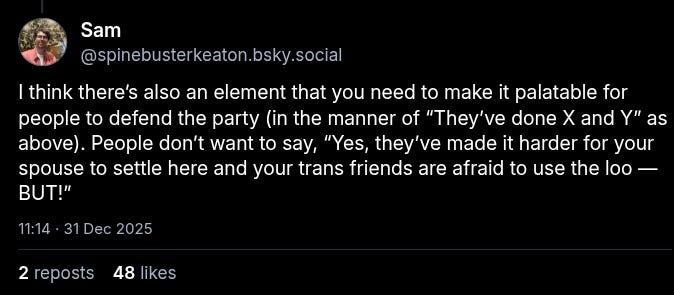
The crucial difference, in other words, is not that Starmer has made enemies, but how much effort his government has put into kicking its friends. The performative harshness of policies towards immigrants or trans people; the ministers or spokespeople who’ve noisily attacked universities, welfare claimants, public sector workers, social liberals – almost anyone, in short, who might be naturally minded to support a Labour government.
They’ve attacked all these people, in a desperate attempt to make clear to racists and social conservatives that they hear them. If the racists and social conservatives were actually going to vote for them this would merely seem abhorrent. When they clearly aren’t, it’s stupid too.
No, it is not surprising that Starmer is so unpopular.
I’ve no idea if this is what Starmer earnestly believes. He’s offered little evidence that he earnestly believes anything, except that he would be good at this job, a belief he will surely have been disabused of by now. I wonder, sometimes, if he thought his instinctive disdain for the political classes, and a fact this view is shared by much of the British public, would be enough.
But it isn’t. You might not need to like those classes to govern – but you do need to work with them. You do, at the very least, need to understand them.
Not doing so is how you end up winning a 174 seat majority, yet with nobody convinced you’ll outlast Gordon Brown.
Animal of the week: terrifying murder beast
Despite what the sort of right wing commentator who can’t open their front door without wetting themselves would like you to think, you are extremely unlikely to be murdered. In London, there were just 97 homicides in 2025, down from 109 the previous year – a rate of 1.1 per 100,000 people. In other cities that don’t benefit from Sadiq Khan’s benign overlordship, the numbers are higher – 2.8 in New York, 3.2 in Berlin, a faintly terrifying 11.7 in Chicago. But even in Philadelphia, where the number is 12.3, you could never leave for 80 years and still have less than an almost vanishingly small chance of being murdered. Murders simply aren’t that common.
Unless, of course, you’re a meerkat.


Keep reading with a 7-day free trial
Subscribe to The Newsletter of (Not Quite) Everything to keep reading this post and get 7 days of free access to the full post archives.