International Services
This week: some scattered thoughts on events in the US; and a surprisingly long-read about why Stratford International station has never seen an international train.

This is gonna be a weird one, I’m afraid. There’s a family medical thing going on that involves the words “significant”, “urgent” and “surgery”, and I’d be lying if I said my head was in the game right. So today’s edition begins with neither the tech-related piece I had planned, nor the coherent US election hot take I’d probably have replaced it with this morning. Instead: some garbled thoughts about yesterday’s elections in the US, followed by something comfortingly nerdy about trains.
This is a hell of a win for Zohran Mamdani. He’s projected to win over 50% of the vote, nearly nine points higher than Andrew Cuomo, and to be the first NYC mayoral candidate to get over 1 million votes since 1969. Okay, we instinctively see big cities as left-wing now, but we shouldn’t underplay this as, “Eh obviously he won, it’s New York”. There are a lot of right-wing people in New York. Both Rudy Giuliani and Michael Bloomberg were mayor of New York. Donald Trump is from New York! This is a big deal.1
All the same, it’s probably not easy to replicate. Mamdani has that once-in-a-generation-political-talent vibe that Barack Obama – or Bill Clinton, or Tony Blair!2 – had. This is a very helpful trick to help parties of the left win elections – but even if it neatly correlated with either policy preferences or achievements in office, which it doesn’t, it’s not something other politicians can somehow just copy.
If there is a lesson here, it’s probably “pick candidates that are right for specific electorates and who say what they mean”? Rather than the endless triangulation “trying to tell people what you think they want” bullshit that the Democrats and Labour alike seem to default to? Again, though, that’s a lot easier to do that with once-in-a-generation-political-talent, and it’s not like anyone has a crop of those to hand.
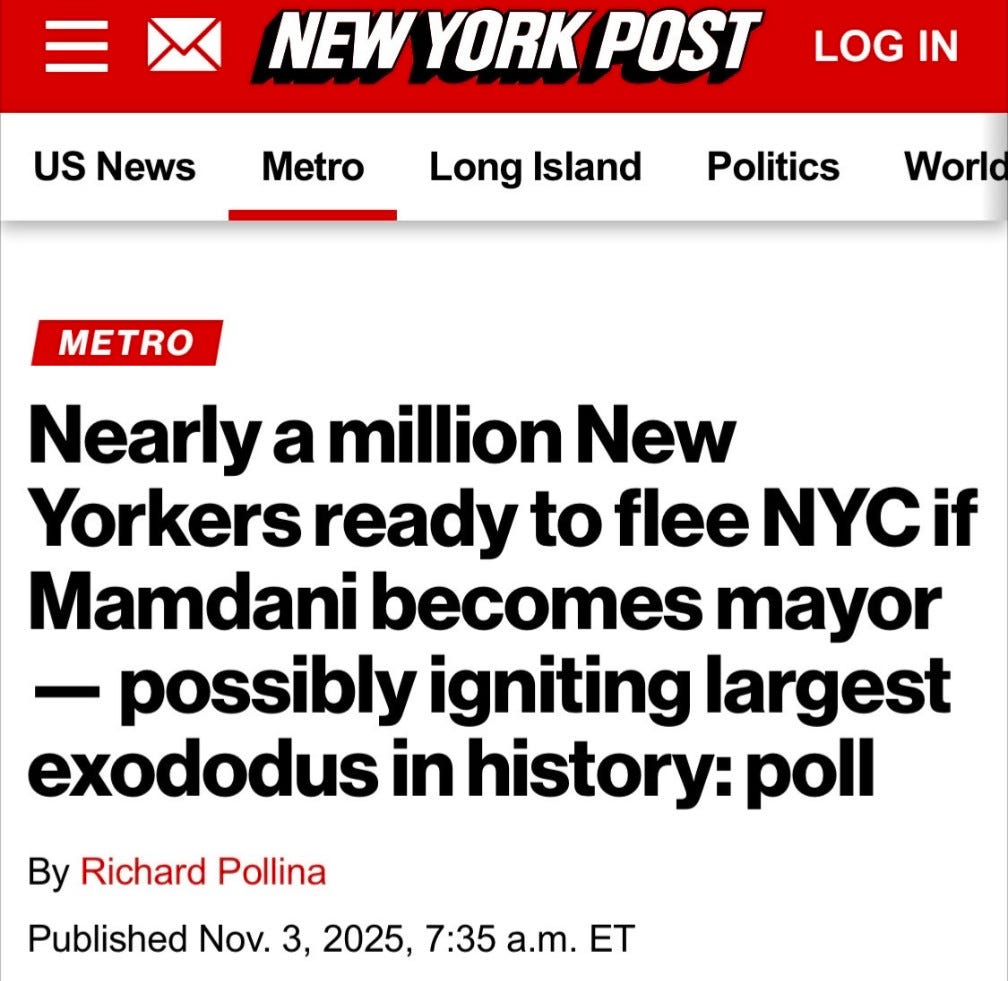
That poll in that screenshot is utter bullshit. One in eight New Yorkers are gonna tear up their entire lives, just because their city elected a mayor with left wing views? Views which, in many cases, he won’t even have the powers to translate into policy? You’re actually going to do that, are you? Oh, grow the f*ck up. We all lose sometimes, get over it. This is either an iffy poll, snowflakes whining or, in all probability – since it comes from J. L. Partners and the Daily Mail – both.
Some of this is hysteria about socialism; but a lot of it is hysteria about Islam. An entire quarter of the global population are, to some degree or another, Muslims: it is objectively mad how many people assume that they’re all secretly Osama Bin Laden. At some point we’re gonna need to have a proper conversation about how Islamophobia is treated like a reasonable, mainstream position.
I know you don’t need me to tell you this, but as ever I think it’s sometimes just worth saying the thing.
Everybody hates Trump. I’ve not been following US politics closely – I’ve been depressed enough as it is – but so far as I can tell the right lost every close election and underperformed its polling averages by several points. This is not normal midterm blues: this is a wave.
That’s probably more about incompetence than evil. I can’t find the post I’m referencing, sorry, but the other day I saw someone quote Anne Applebaum saying that the biggest threat to tyrants is when they forget to deliver for their people. That suggests the danger for Trump and co is not that everyone is actually a lot more left wing than we thought: it’s that the president is a man who feels no need to sugarcoat the fact he doesn’t give a shit about other humans, even the ones whose support he requires.
To put that another way – and I’m not saying I’m happy about this – I suspect the “creeping fascism” stuff will hurt him a lot less than the “cutting benefits and services middle America relies on” stuff.
To wrap up: three posts I am not going to be able to top. My recovering podcast colleague Dorian Lynskey:

The FT’s Henry Mance:

And an actual American, writer Kashana Cauley:

All of which makes me think that…In a sane politico-media culture, the right would view this as a rebuke.
I bet they don’t, though. I bet they go straight to demonising the voters.
I hope, next time we meet, to be able to think in full paragraphs once again. Until then, here’s some stuff I made earlier.
Bigging Up My Mates
There’s a thing called the Anthony Howard Award, a sort of journalistic bursary which funds placements for young writers to work at the New Statesman and the Times, and is named for a man who had illustrious careers at both. When I was on staff at the NS, that meant a stream of bright young things who’d pass through the office for a few months, before disappearing off to pastures new.
One such BYT we liked so much the powers that be gave him a job – which was great, because it meant I could lock him in the recording studio and make him talk about mayoral elections or the architectural history of Southport3 or whatever else I fancied babbling on about for that week’s episode of Skylines, the CityMetric podcast. All that, though, was a long time ago now, and somehow when I wasn’t concentrating he went on to be Chief Political Commentator at the Times. Bloody hell I got old.
Anyway: the great Patrick Maguire has launched a newsletter to do “deep cuts on obscure political history and what it tells us about”, and if that sounds like your thing you should subscribe. That’s the point here.
When is an international station and/or depot not an international station (and/or depot)?
There have been seven British railway stations with “international” in their name. One (Waterloo International) lost the tag because the Eurostar moved to another (St Pancras International). One (Birmingham International) was named after an airport, and even though that airport is no longer technically called that (it’s now just Birmingham Airport, though it does remain international, so heaven knows why) this seems fair enough. One is named after a seaport (Harwich International, renamed from Harwich Parkestone Quay in 1995). And two (Ebbsfleet International and Ashford International) aren’t served by international trains today, but – until the pandemic made Eurostar rethink its stopping pattern – were, and are consequently now looking a bit sad.
That leaves one – whose name is by far the most mystifying of the lot. Stratford International lies in the International Quarter at the end of International Way. It can offer regional HS1 services to Kent4 (including via Ebbsfleet and Ashford). It has a DLR station, from where you can get trains to all sorts of places, so long as you don’t need to go beyond London zones 2-4: to do that, you need to change at Stratford [regional], across the shopping centre and one stop up the line. It is not quite true that Stratford International has never seen an international train: it sees them rather a lot. What is true, however, is that they don’t stop. Not once; not ever.
What, you might wonder, the hell?
What the hell, in short, is this. When the Channel Tunnel opened in 1994, a mere eight years after tunnelling commenced, trains to London ran initially through the Kentish suburbs and ended up in Waterloo. This seemed to make sense – although Waterloo mostly serves points south west, it is south of the river, has an SE1 postcode, and so forth, so being the terminal for points a long way south east and across the sea was not entirely insane.
That, though, was only ever meant as a temporary measure: the plan all along was to divert the trains through a specially built line (known at first as the Channel Tunnel Rail Link, later as High Speed 1), where frequency wouldn’t be limited by the need to not bang into other trains. This, it was decided in the early 1990s, should terminate at St Pancras: partly because it allowed easier connections on to points north; partly because the building was a helpful combination of grand, enormous and barely used; but partly also because a new high speed line approaching London from the east offered regeneration opportunities and Michael Heseltine, who was into such things, was the one making the decision. And so in 2007, Eurostar moved its London terminal from Waterloo to St Pancras.
Stratford International, in a regeneration-hungry corner of industrial east London, was the first stop up the line. That, though, didn’t open until 2009, the year that Southeastern began running high speed domestic rail services on HS1. This is not in itself weird – Stratford International is only a few miles from St Pancras, and forcing Eurostars to stop when they’d barely got started would mean delaying journeys for no obvious benefit. The St Pancras services were never the international trains that were meant to stop there and justify the station’s name. The ones that did that were these:
