Some odd straight lines on maps
Illusory straight lines in Australia, and unexpected ones in Western Sahara.

Okay, no more Mr Nice Blogger: producing my trademark mix of news, views and nerdery every Wednesday afternoon takes time. If you fancy reading but can’t afford it then hit reply and ask, and you can have it. I will say yes: I always do. (If you asked and I did not reply, it’s because I missed the email. Really, ask again.)
If however you can afford it, and you don’t want to wake up and discover I’ve been replaced by an unconvincing AI, and Henry Scampi now looks like K-9, then– in the words of the great Ian Dunt – pay up you bastards:
Here are two examples of the sort of thing you’ll receive every week. Paying subscribers got this one in July…
I am, give or take, halfway through the process of writing the new book.1 When finished it will be, I hope, good; but I cannot say yet that it is, and I always forget this bit even though it’s inevitable, and it sucks. There have been moments at which I found myself wistfully wishing I was instead writing what I’ve taken to thinking of as 2History 2Borders.
One of those moments came one Saturday a few weeks back, when I received an email from Dr Peter Merrotsy of the University of Western Australia:
Hello Jonn!
Have just enjoyed reading your Borders book. You mention (Borders from a land down under) the SA–Vic–NSW surveying error: in case you do not already know it, the term MacCabe Corner will be of interest, and the Google map of the borders and Murray River there look impressive.
So I looked at the map. And I have to say he is not wrong.
First, a map of the states and territories of the great nation of Australia. The eastern boundary of South Australia appears, at first glance, to be a straight line; MacCabe Corner is the tripoint where the state meets both New South Wales and Victoria. Simple, right?
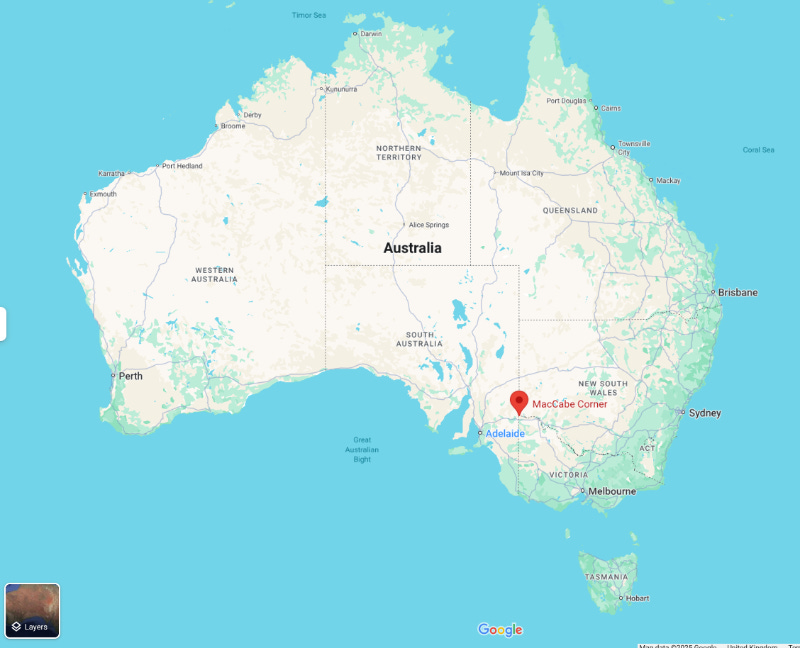
Wrong. Zoom in:
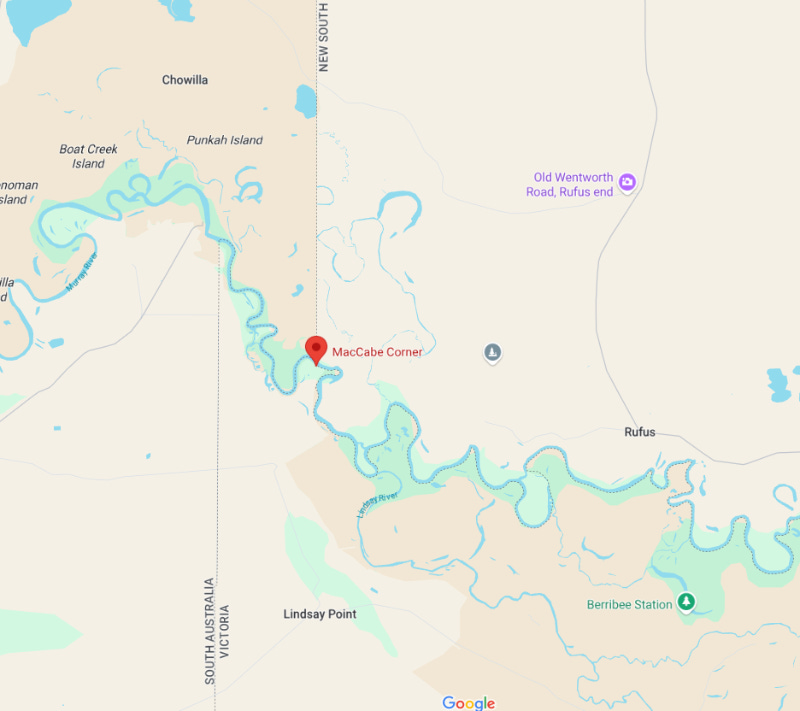
…what?
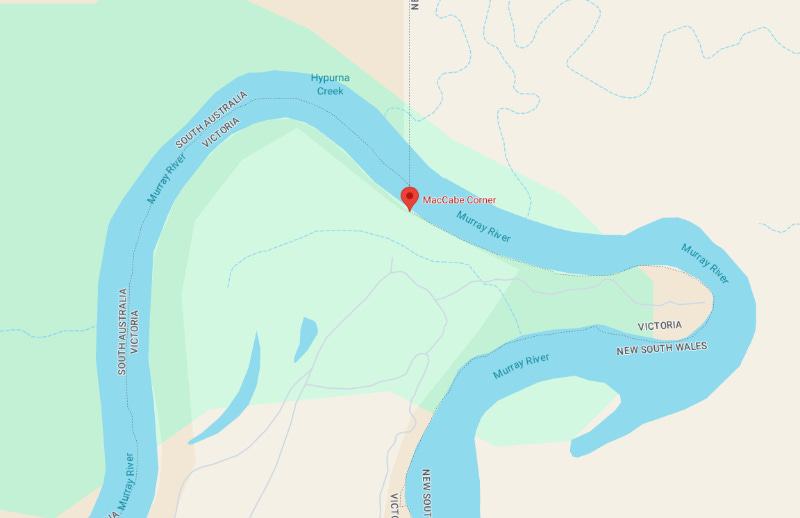
What??
The first problem is that, despite its reputation, MacCabe Corner is not in fact where the three states meet at all. The border between Victoria and South Australia lies at the midpoint of the Murray River; but the boundary between Victoria and New South Wales runs along the southern bank of the Murray River.
That means that the tripoint, where all three meet, is out in the middle of the water. But they’ve put the signage marking MacCabe Corner on dry land, the cowards: it’s at a point roughly 100m from the nearest bit of South Australia which lies, confusingly, to the north. MacCabe Corner isn’t really the tripoint at all: it actually marks the south west corner of New South Wales.
But hang on – why is the river coming into play at all? The eastern boundary of South Australia, after all, is supposed to be a long, straight north-south line (a meridian, in the jargon). Why doesn’t it just cut across the river without stopping?
Well, it should have done: the border of South Australia was supposed to be the meridian 141 degrees east of Greenwich. The problem is that 19th century surveying technology was not all it’s cracked up to be, and those who surveyed it accidentally put it roughly two miles west of where it was meant to be. South Australia, as the state which had lost out from the error, was keen to correct it. But after a 70 year legal dispute – which I cleverly distilled into about two sentences of my book (p247-8) – the courts said that it would be too much of a hassle to move an established state border unless all parties agreed.
And so, Victoria uses the original, wrong calculation while New South Wales uses the new, correct one – and what looks like a straight line on a map isn’t.2
MacCabe – named, with some irony, after a surveyor – is not the only named corner in Australia. In fact there are five of them where, or at least roughly where, states and territories meet. Here’s a map:
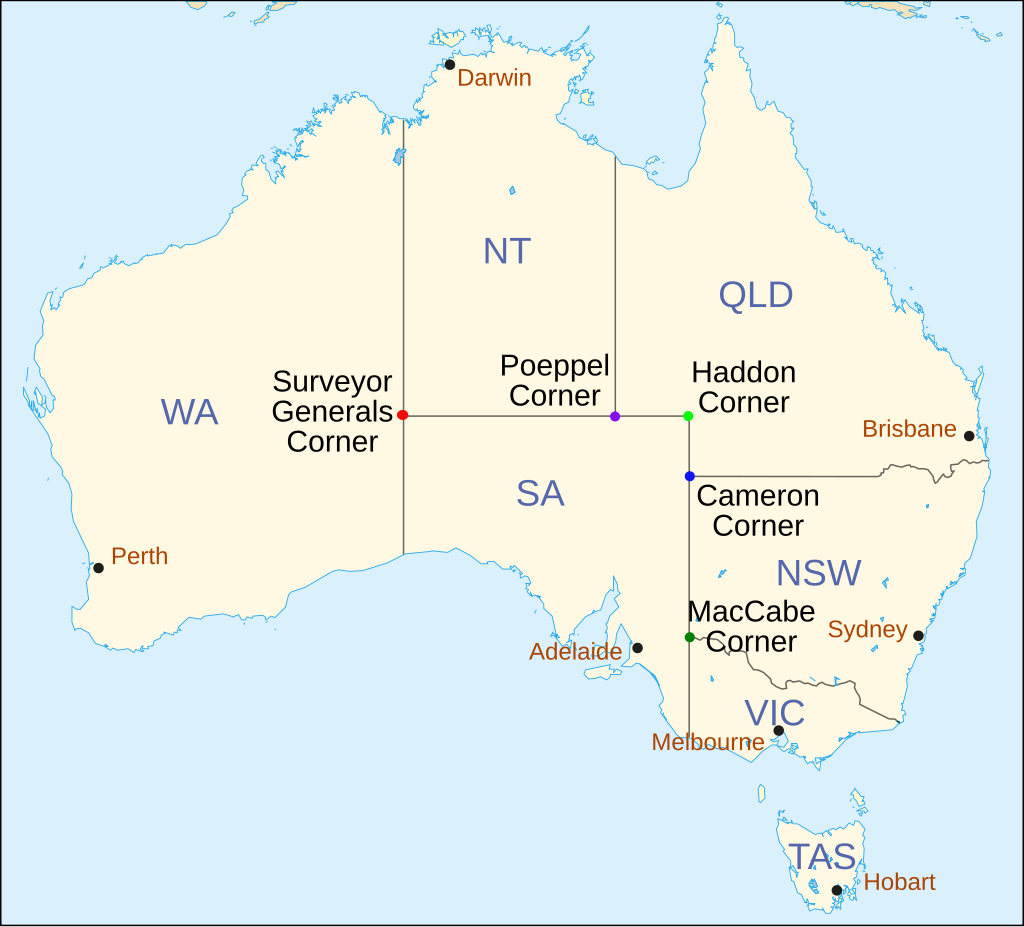
The others aren’t quite so exciting. (How could they be.) But there is another discontinuity at Surveyor General’s corner, after it turned out that the north-south lines drawn through the centre of obelisks in Deakin and Kimberley – both supposedly the 129th meridian east – didn’t quite line up. That resulted in two corners, which fits nicely with the fact the corner isn’t named after a single surveyor general but the profession in general.
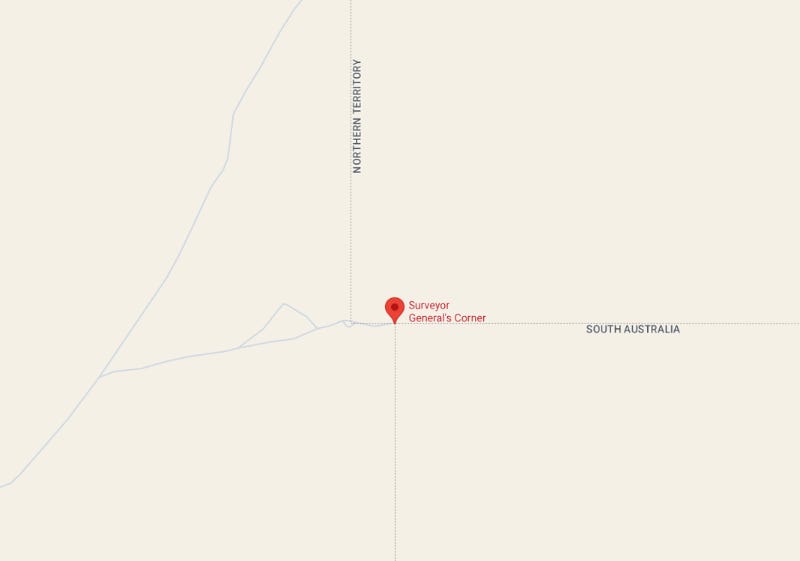
On, and at that corner – as at Poeppel and Cameron – different time zones mean it is possible to celebrate New Year three times over two hours. But all these corners are so far from anywhere that it won’t be much of a party.
More from the helpfully clearly-named Backpacker Jobboard website here.
Also from July (albeit a week later)…
Amazing/horrifying object of the week: the world’s longest conveyor belt
Look at this satellite image. Look, specifically, at the discontinuity in the middle, the clear line stretching 61 miles through the desert.
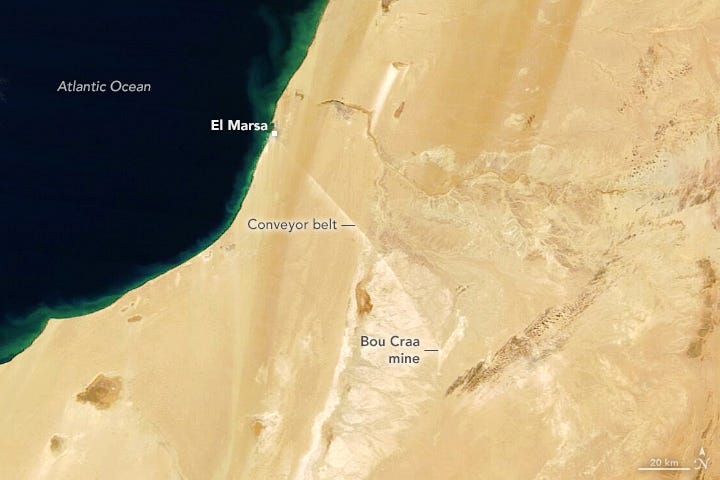
That is a massive conveyor belt – the world’s longest in fact. The white line is not the belt itself (that, like the Great Wall of China, is too narrow to be visible from space with the naked eye) but the impact it’s having on its surroundings, in the form of the dust blown from it.
The belt carries 2,000 tonnes of phosphate rock every hour from the Bou Craa phosphate mine to the coastal town of El Marsa. Why bother with that? Well I’m very glad you asked: phosphorus is one of the most important nutrients used in commercial fertilizer. The rock that contains it is mined mostly in the US and China, which are huge – but also Morocco and Western Sahara, which are not. The latter is believed, by the US Geological Survey, to contain 70% of the world’s supply, and to be responsible for 17% of all the world’s production. Blimey.
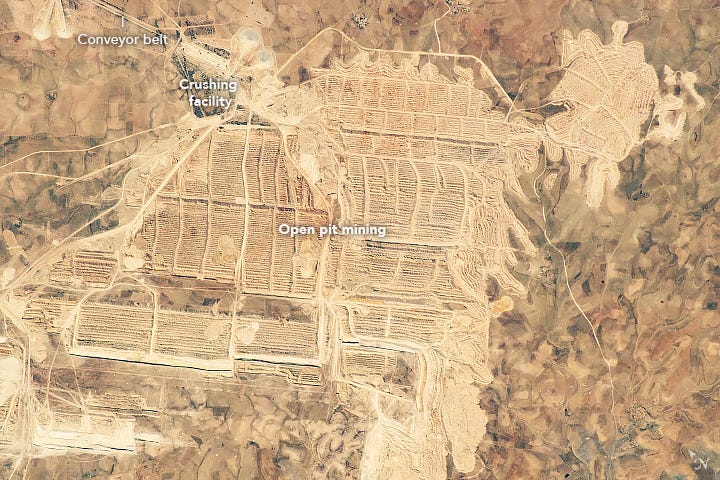
Hence the importance of this massive conveyor belt, and the enormous open cast mine it connects to the coast. This is a massive, massive export.
Western Sahara, incidentally, is the most sparsely populated area in Africa, and one of the most sparsely populated in the world – just 5.7 people per sq km; more than Mongolia (just), the Falkland or Pitcairn Islands or Greenland (just 0.4 people per sq km!), but less than literally everywhere else. The reason for the slightly awkward construction “Morocco and Western Sahara” is that it’s contested between Morocco and the Sahrawi Republic, which is seeking independence. That conflict has been going on since 1976, until which the territory was known as Spanish Sahara; but when Spain tried to transfer its sovereignty to Morocco and Mauritania, in defiance of an International Court of Justice ruling, war broke out.
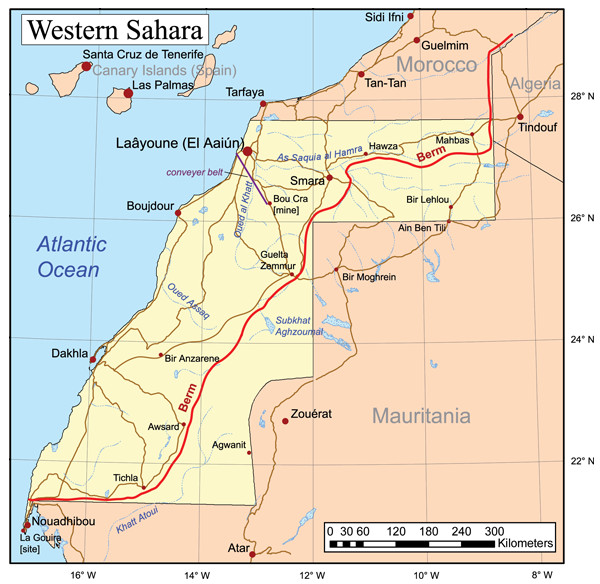
One odd side effect of this is that the UN and several other international bodies thus argue that Spain remains the de jure (though not de facto) administering power. That means that Western Sahara is often referred to as “Africa’s last colony”, even though the Spanish have largely washed their hands of the place. Alas for those hoping for their freedom, it’s Morocco that gets the benefits from the mine.
(Hattip: Lance Parkin. Read his Gene Roddenberry biography! It’s great! A guest post he wrote for this newsletter here.)
And if you still want to get a good deal out of me, then A History of the World in 47 Borders is currently available for just 99p on Kindle or Kobo.
If you, too, noted that “the process of writing” is not quite the same as “writing” then all I can say is piss off.
I’m pretty sure that following the correct line would have left Victoria with an awkward bit detached from the rest of the state, so I wonder if that might have been a factor in decision making, too? But I’ve not checked the court records, hence, footnote.