When is an international station not an international station?
The great Stratford mystery.

On Friday morning, I woke up to discover that Matt Goodwin was not, as he had threatened to become, a member of parliament. This has, it may not surprise you to learn, genuinely cheered me up.
However: he still has more newsletter subscribers than I do, a fact that never ceases to shock all decent people. If you want to help correct this shocking indictment of the world today, please hit the button below. I’ll even give you a discount, to reflect the percentage he lost by.
This week’s taster of what lies beyond the paywall comes from last November. Enjoy.
There have been seven British railway stations with “international” in their name. One (Waterloo International) lost the tag because the Eurostar moved to another (St Pancras International). One (Birmingham International) was named after an airport, and even though that airport is no longer technically called that (it’s now just Birmingham Airport, though it does remain international, so heaven knows why) this seems fair enough. One is named after a seaport (Harwich International, renamed from Harwich Parkestone Quay in 1995). And two (Ebbsfleet International and Ashford International) aren’t served by international trains today, but – until the pandemic made Eurostar rethink its stopping pattern – were, and are consequently now looking a bit sad.
That leaves one – whose name is by far the most mystifying of the lot. Stratford International lies in the International Quarter at the end of International Way. It can offer regional HS1 services to Kent1 (including via Ebbsfleet and Ashford). It has a DLR station, from where you can get trains to all sorts of places, so long as you don’t need to go beyond London zones 2-4: to do that, you need to change at Stratford [regional], across the shopping centre and one stop up the line. It is not quite true that Stratford International has never seen an international train: it sees them rather a lot. What is true, however, is that they don’t stop. Not once; not ever.
What, you might wonder, the hell?
What the hell, in short, is this. When the Channel Tunnel opened in 1994, a mere eight years after tunnelling commenced, trains to London ran initially through the Kentish suburbs and ended up in Waterloo. This seemed to make sense – although Waterloo mostly serves points south west, it is south of the river, has an SE1 postcode, and so forth, so being the terminal for points a long way south east and across the sea was not entirely insane.
That, though, was only ever meant as a temporary measure: the plan all along was to divert the trains through a specially built line (known at first as the Channel Tunnel Rail Link, later as High Speed 1), where frequency wouldn’t be limited by the need to not bang into other trains. This, it was decided in the early 1990s, should terminate at St Pancras: partly because it allowed easier connections on to points north; partly because the building was a helpful combination of grand, enormous and barely used; but partly also because a new high speed line approaching London from the east offered regeneration opportunities and Michael Heseltine, who was into such things, was the one making the decision. And so in 2007, Eurostar moved its London terminal from Waterloo to St Pancras.
Stratford International, in a regeneration-hungry corner of industrial east London, was the first stop up the line. That, though, didn’t open until 2009, the year that Southeastern began running high speed domestic rail services on HS1, because the Eurostars themselves never stopped.
This is not in itself weird – Stratford International is only a few miles from St Pancras, and forcing Eurostars to stop when they’d barely got started would mean delaying journeys for no obvious benefit. The St Pancras services were never the international trains that were meant to stop there and justify the station’s name. The ones meant to do that were these:
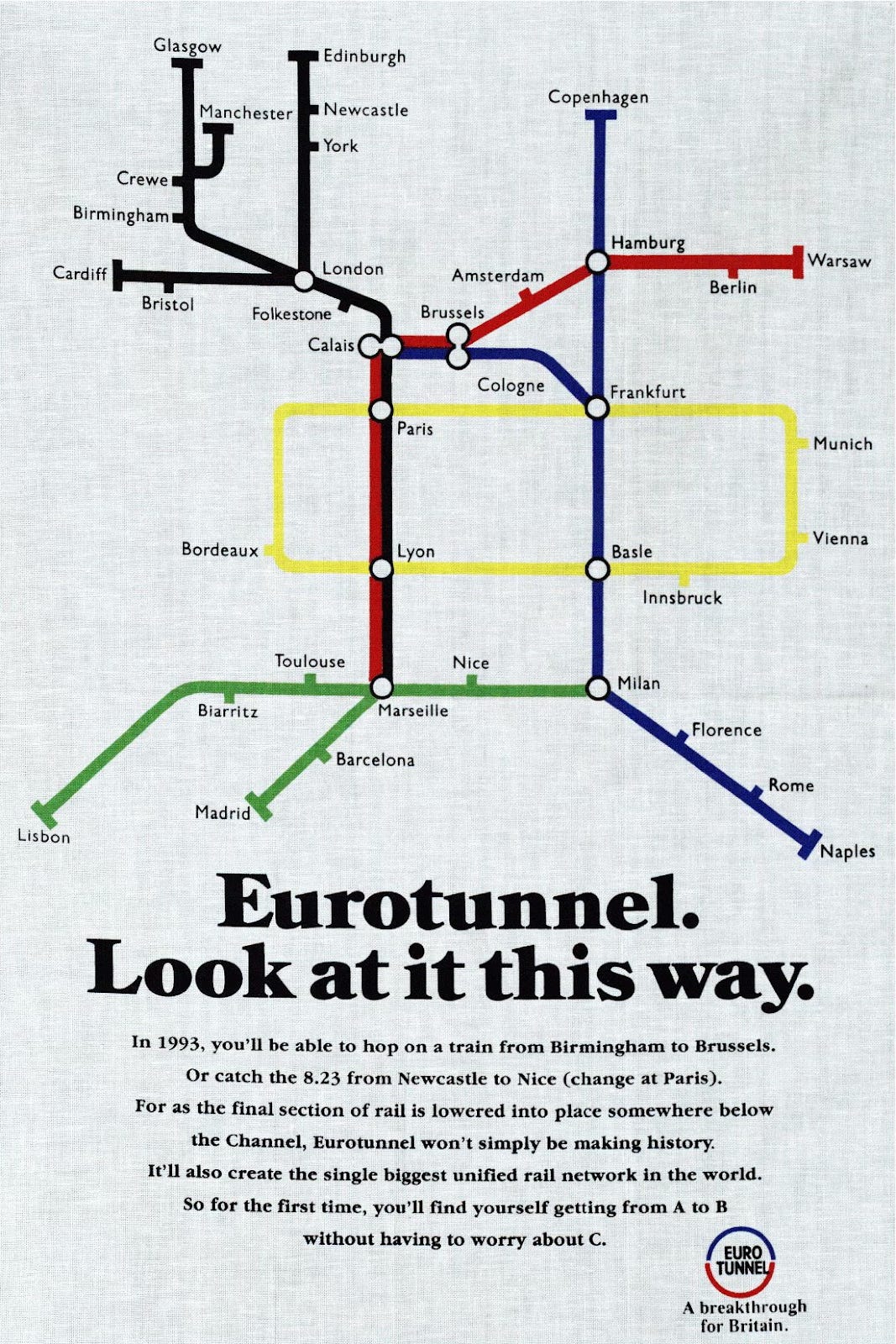
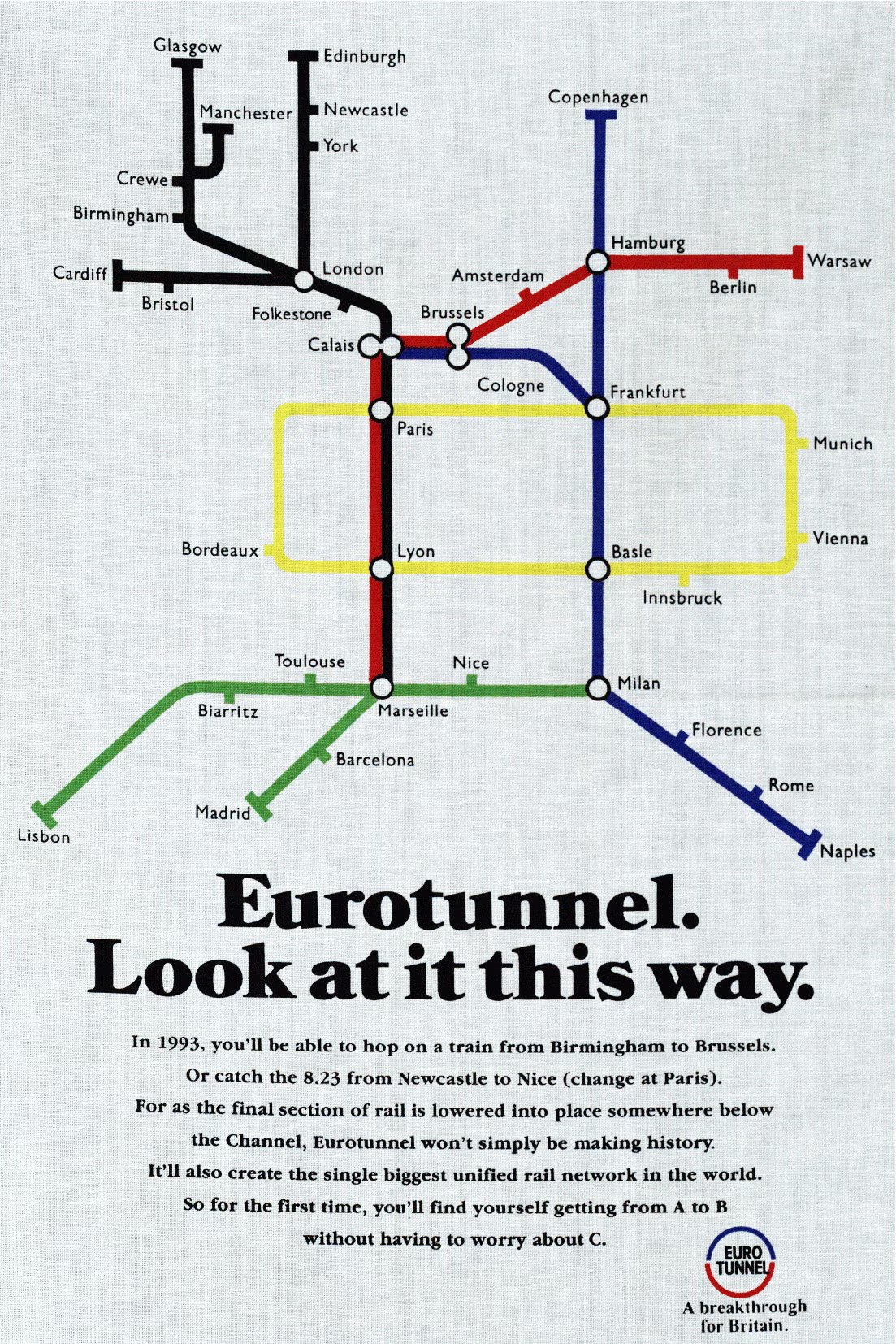
This is a newspaper promo for Eurotunnel, the company building the new tunnel, dating from sometime in the late 1980s. The Tube-style map of European rail services is to a great extent an ad man’s whimsy; the black services, though, were genuinely meant to exist. Regional Eurostar trains were meant to run to every corner of this island: day services via the East Coast Mainline to Glasgow and the West Coast Mainline to Birmingham and Manchester; Nightstar services on the same routes, as well as via the Great West Mainline to Plymouth and Cardiff.
A lot of public money was spent on infrastructure to facilitate all this: by 1999, the cost of facilities, track connections, a fleet of seven 14-coach British Rail Class 373/3 trainsets and a place to keep them had added up to £320m (close to twice that in today’s money).
One of the more visible fruits of all this largesse was – we got there eventually – that shiny new station of an industrial east London suburb. Stratford International was to be the London stop on the regional Eurostars, analogous to the Marne-la-Vallée–Chessy station which enables long distance trains to skirt Paris while still providing a stop in the Île-de-France (as well as enabling those who fancy it to stop off at Disneyland). It meant that trains would avoid the absurdity of passing through one of the largest cities in Europe without stopping at all, while also not serving the city so well that London passengers would be tempted to take up valuable space intended for those from elsewhere.
Although the new Stratford station was probably the most obvious bit of shiny new rail infrastructure to get slapped with the word “international”, it wasn’t the only one. London & Continental Railways (LCR) built a new depot for those 373/3s in Longsight, a beautifully named suburb three miles south of Manchester city centre. The sign outside the Manchester International Depot, as it was named, for many years read, “le Eurostar habite ici”. Alas, le Eurostar ne habite pas. Look upon my trains ye mighty, et trembler.2
One reason none of this ever happened was rail privatisation. When first proposed, the regional Eurostars would have been operated by a subsidiary of British Rail. Long before they could open however, its assets had been transferred to a private company, the aforementioned LCR. Private companies are not, as a rule, enthused about launching unprofitable services.3
And before regional Eurostars could begin, it was already clear the original London services were not seeing the demand that had once been anticipated. In the 21 years between the 1986 Treaty of Canterbury paving the way for the Channel Tunnel, and HS1 opening in 2007, Europe had experienced the cheap flights boom. Suddenly it was possible to fly between regional British airports and the continent for dozens, rather than hundreds, of pounds. A train ticket would be more expensive. It would also take a lot longer – nine hours, from Glasgow to Paris, more than enough of a difference to justify the faffing around getting to and from the airport. All this was good news for business travellers and holidaymakers on a budget; it was bad luck for both Eurostar’s business model and also, let’s be honest, the planet.4
Lastly, there was the question of passport checks, which take up quite a lot of space at St Pancras, and have limited Eurostar’s expansion on the continent. Stratford International had space built in; it’s not clear all the regional stations would have it. One possibility discussed at the time was doing the checks on-board. It is hard to see the Home Office ever signing off on such a thing.
Some of these problems would have been obvious at the time, of course, and no one seemed fussed then: the conspiracy theory version of events is that the provinces were promised the impossible to persuade them to back an expensive project that would actually only benefit the rich south east. In 1999, a parliamentary select committee thundered that the “regions have been cheated”.
Maybe. But the rise of cheap flights really was an unexpected development that changed the market for international travel – and I find the idea that the British state might spend £320m on a station, a depot and a fleet of trains for services that would never end up running out of nothing more than a cocktail of bad luck and incompetence horribly convincing. There are real conspiracies in the world, yes; but cock ups are far more common.
The prospects for regional Eurostars in future do not look great. Sure, flights have become more expensive, and travelling by train more fashionable. But the price difference remains, and there’s now a whole new practical problem that wasn’t there in the 1990s. The original plan would have seen trains connect to points north and west via HS1 and the North London line. In 2007, though, the latter was swallowed by the London Overground to become what’s now the Mildmay Line. You probably can run the occasional international train in between stopping services along an unloved Cinderella service; trying to do so via a high frequency metro line, though, is quite clearly nuts.
That would not be an issue if someone had built less than a kilometer of track immediately north of St Pancras to connect HS1 with HS2. That, though, was omitted from the final HS2 bill, after objections from local businesses, homeowners and Camden council. By the time that happened in 2017, it was pretty clear there was no market for regional Eurostars, admittedly – but all the same, making it impossible to run high speed trains from the regions to the continent because of a few dozen people in north London seems just a tiny bit on the nose. At any rate, that Manchester International Depot is likely to remain tragically regional. As things stand, it’s used by Northern Trains.
Stratford International, though, may have a less absurd future. One of the barriers to expansion and thus cheaper ticket prices at St Pancras is the physical space limitations that would make it hard to speed up passport checks. One possible solution – proposed by start-up Gemini Trains, as part of a consortium with Uber – would be to terminate services instead at Stratford. The plan would bring Ebbsfleet International back into international use, too.
Gemini, it’s worth noting, have no current prospects of actually doing this. (Indeed, the competition for space at the Temple Mills depot, not far from Stratford, was just won by Virgin. Eurostar, sporting as ever, are considering legal action.) But HS1 Ltd, which owns the station, still maintains that the reason it hasn’t changed the objectively absurd name of the station is because it “is on the international line and it has been built to accommodate international passengers at some point in the future”. Maybe, just maybe, it one day won’t be so absurd after all.
If you enjoyed that and would like to read more things by me but can’t afford a subscription, just hit reply and ask: I will say yes, no questions asked. If you can afford one, though, then it might annoy Matt Goodwin and you can even have a discount:
You also may wish to pre-order my new book, 35 Inventions That Built Our Word: The Making of Modern Life.5 It’s out in August, pre-orders really help in terms of visibility and later sales, and go on, it’ll be very motivating over the next month as I push to finish the thing.
The fact Britain has built precisely one high speed rail line, and it serves one of the Home Counties, will never cease to be a damning insight into the way this country functions.
While researching this I came across a smug piece on Kent Live (“Why Ashford and Ebbsfleet railway stations are called International”), which noted Stratford’s poor, international train-free status, and the possibilities (we’ll get to that) this might change. “Whether that happens in the future at Stratford International remains to be seen,” it reads, “but for now Kent can proudly say it’s home to two of only three truly international stations in the country.” Given that the date on the piece is 30 January 2020, all of six weeks before the arrival of the British bit of the pandemic that would kill international services at those stations, quite possibly forever, this too feels a bit on the Ozymandias side.
So well did LCR’s business work it was nationalised again in 2009.
Let’s pause briefly to think about that time scale. I can remember complaints aplenty about how long it took to build the Channel Tunnel Rail Link/HS1, and jokes on television, possibly even in the opening credits of Have I Got News For You, about how futuristic high speed trains through France would then magically transform into rusty, flatbed trucks the moment they surfaced in Kent. And yet, the new line opened just 13 years after the Channel Tunnel, which took just eight years to open after construction was agreed. HS2 received royal assent in 2017, will not open before 2033, and even when it does it’ll be a fraction of the size originally proposed. Something has gone wrong.
I do know that’s not what the Waterstones page says: you would not believe how many times a title can change – or the anxiety dreams it can induce.