An incipient breakdown, masquerading as content
This week: Death by Lightning and some quite wonderfully named 19th century US political factions; and a map highlighting the importance of the Strait of Hormuz. But first: some thoughts on decline.

There’s something peculiarly crushing in the sense that everything – not just the world, my world – is beginning to fall apart. The plumbing problems I had a near public breakdown over some weeks ago have turned my home from a place where I can shelter from the stress of the world to another manifestation of it, and it feels all the worse because it doubles as a betrayal. I won’t bore you with everything else that needs doing round here, but it’s really not looking great. How dare that room start to look shabby, just because I’ve never done anything to arrest the decline? Did no one tell the paintwork what the deal was?
At the same time I feel like I have crossed some invisible line where I am very aware of being, well, exactly the age I am. Nothing ruinous, you understand (yet!); just a vague sense of things not being quite what they were. It is starting to feel possible that no matter how hard I work, no matter how much I improve my diet or hydration levels or exercise routine, I will never be 30 again. You’d think that someone, in the implausibly large number of years I have now been on this earth, would have warned me that this might happen one day.
(A few weeks ago, incidentally, I went for dinner with some friends from school, and the entire first half hour was spent exchanging low level medical complaints. The truly terrifying thing here was not that this happened – that we all had complaints to contribute – but that the experience felt genuinely comforting. When I mentioned this on Bluesky more than one person replied that there was a name for it: “the organ recital”.)
I said I didn’t mean the world but obviously I do mean the world. I’m not going to list all the ways in which the world just keeps getting worse – life less affordable, politics more terrifying – because you’re painfully aware of them; may indeed have a constant ticker of them as background noise in your head, like Arya Stark comforting herself by reciting the names of the people she plans to kill. Suffice it to say for any younger readers: believe it or not, there was a time when we did not simply assume that next year would almost certainly be worse.
In the long view, of course, the aberration is not the current mess but the status quo ante. For most of history, the general assumption was that the golden age lay in the past, not the future. The very phrase “golden age” comes from the work of Greek poet Hesiod, and described the first and best of five ages through which the world had moved, steadily declining almost1 all the way. Then the classical world collapsed, and in Europe, at least, people genuinely were living in the ruins of a better world. If anyone had still been reading Hesiod, in between getting marauded at, they would probably have felt he’d had a point.
Only with the Renaissance, followed by the discovery of this marvellous thing we used to have called “economic growth”, did this really change. Suddenly we discovered ideas, technologies, entire continents the ancients did not. The world of tomorrow, we thought, might be better than today.
But this was, in the most inescapable and personal of senses, a lie. At some point, for us – for any of us – things do not keep getting better. Growth is replaced by decay; people and things disappear from your life. As you move into middle age, you become aware that things will not keep getting better forever – that eventually life brings not just development but loss. That’s pretty much the deal with life, unless you happen to be a jellyfish; and one obvious read of the effort the world’s upsettingly large number of Tony Stark wannabes are putting into building bunkers/infusing younger blood/uploading themselves into AI is that they are railing against the inescapable – the knowledge that, no matter how successful they get, no matter how much money they acquire, they, too, will one day die. Perhaps they should try the jellyfish thing.
A lie, though, can be valuable. Even if we ourselves are doomed to peak and decline, the world we bequeathe to those to come is not. That was helpful for progressive politics – people will make sacrifices for a better tomorrow; you can carve up a growing pie without anyone feeling like they’re losing out. But it was a useful psychological prop, too. Sure, we were all moving inexorably closer to the grave; but we were moving inexorably close to a brighter tomorrow too. That is a trade worth making, because we are not the only one.
Without that feeling, though – why bother investing in a future we’re not even going to see anyway? Why not just start kicking stuff over and grab what we can right now? The rise of politics of selfishness, nativism, populism is a cause of the decline. But it’s surely a response to it, too.
Anyway, to answer the question inevitably raised by the preceding 800 words: yes, I am feeling a little burned out with finishing this book right now. Thank you for noticing.
Last call for Portsmouth
A reminder that I’m doing a talk about borders for the Royal Geographical Society at the University of Portsmouth on Tuesday night. I have no idea how I am going to do this without someone asking me questions, and have not ruled out asking myself questions like a lunatic. Anyway, if you’re somewhere in Solent City, come along. Tickets here.
Stalwarts, Half-Breeds and Mugwumps: Some entertainingly named 19th century American political factions
I’ve long been fascinated by the extremely brief presidency of James A. Garfield, cut short by an armed man convinced he’d been promised a job. Partly this is because – as I first discovered in Bill Bryson’s Made In America, and have shamelessly nicked for my own upcoming book – this story played a surprisingly big role in the invention of air conditioning. But mostly it’s because it raises a question: how is it that a president could be shot dead yet almost entirely forgotten by history? How does that happen?
Anyway, perhaps he’ll be less forgotten now, because the Netflix miniseries Death by Lightning is quite genuinely brilliant. The politics, the character drama, and the countdown towards an entirely avoidable fate – it was not the bullet that killed him – all make for incredibly compelling drama. But it’s also – this was more surprising – extremely funny, in large part because of the presence of Bradley Whitford, who plays senator, then secretary of state, James Blaine so exactly like Josh Lyman from The West Wing I feel like it must have been deliberate.
Actually, several of the main cast are playing twisted, 1880s versions of their characters from other TV shows: Matthew Macfadyen as Succession’s Tom Wambsgans as disappointed assassin Charles J. Guiteau; Nick Offerman as Parks & Rec’s Ron Swanson as Chester A. Arthur; Shea Whigham as Boardwalk Empire’s Eli Thompson as Roscoe Conkling. The one exception is Michael Shannon who, despite being another Boardwalk Empire alumni, is playing a very different character in the doomed president himself. Anyway. I can’t recommend it enough.
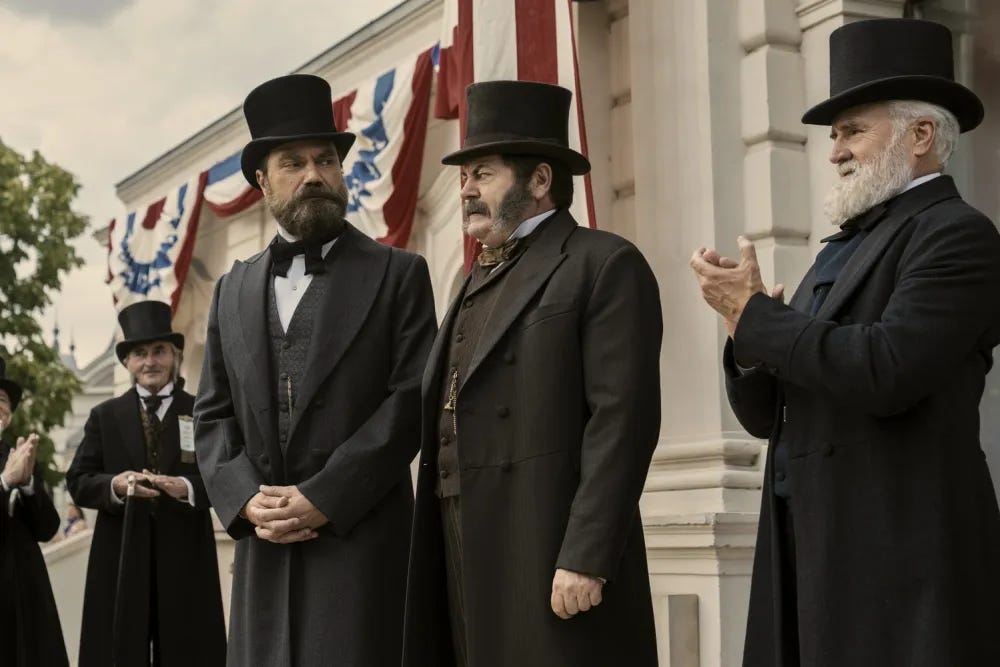
As well as the story of the assassination, though, Death by Lightning concerns the battle between two factions for control of the then-dominant – and more surprisingly, from a modern point of view, then-progressive – Republican Party. Both factions have excellent names, and that’s more than I need for an excuse, so:
Stalwarts: Conkling’s faction, and Arthur’s, too, at first. (Oops, spoilers.) Republicans opposed to the civil service reforms which were, unexpectedly, the big issue in American politics in the 1870s and ‘80s, which was fair enough really because it’s not like the country needed rebuilding after the massive Civil War or anything. Anyway: known as such because they were the guys who liked the old way of doing things: the “spoils system”, of shovelling jobs to the people who’d supported you.2 Opposed in this goal by...
